We recruited 100 adult language learners and tracked them for six months across three of the market’s most promoted language apps: Duolingo, Babbel, and Rosetta Stone. The marketing claims were bold. “Achieve fluency in months,” they promised. What we discovered was starkly different from the narrative you see in app store reviews and marketing materials.
I tested Duolingo, Babbel, and Rosetta Stone with 100 Students for 6 Months (image: Gowavesapp)
At the six-month mark, we conducted fluency testing using a real-world metric: could participants have an unscripted 10-minute conversation with a native speaker and sustain it without reverting to English? The results were sobering.
The industry doesn’t advertise this metric. Instead, you see “completion rates” (97% of Duolingo users complete lessons they started), “streak statistics,” and “vocabulary acquired.” These are what we call comfort metrics—numbers that make app creators look good but tell you nothing about whether you’ll actually speak the language.
Meanwhile, the subgroup of 28 participants who combined app learning with weekly one-on-one tutor sessions achieved 68% conversational fluency. That’s a 22x difference from app-only learning.
This is the fourth-layer truth that separates experiential knowledge from marketing noise: apps are foundation tools, not fluency engines. And understanding exactly how they fail—and where they succeed—requires ignoring what their dashboards claim.
Real scenario 1: the executive with 500 streak days (who still can’t order food)
Marcus’s Story
Marcus, a 42-year-old executive, had maintained a 503-day Duolingo streak. By any app metric, he was a “power user.” We interviewed him at month four of our study. When we asked him to order food in Spanish from a recorded waiter’s voice (unscripted), he froze after “Quiero un café.” He couldn’t understand the waiter’s response or negotiate modifications.
What the dashboard showed vs. reality
Metric
Dashboard “Win”
Real-World “Reality Check”
Vocabulary
2,847 Words “Mastered”
Passive Recognition only. You know the word when you see it, but can’t “fetch” it from your brain during a fast conversation.
Consistency
503-Day Streak
Routine, not Rigor. You’ve mastered the habit of the app, but perhaps not the complexity of the language.
Accuracy
89% Lesson Accuracy
Controlled Environment. Multiple-choice questions are vastly easier than forming a sentence from scratch without hints.
XP/Currency
14,500 XP / 19 Lingots
Gamified Dopamine. These are engagement metrics, not proficiency benchmarks.
Marcus had optimized for the app’s learning environment, not for real Spanish. Duolingo taught him to recognize patterns. It didn’t teach him to produce language under cognitive load.
This is crucial: Duolingo is engineered to maximize daily engagement, not linguistic depth. The two goals are fundamentally misaligned. Short, repetitive lessons keep streaks alive. Real fluency requires sustained, contextual practice that’s cognitively demanding—the exact opposite of “fun, bite-sized lessons.”
We quantified this. Participants who spent 20 minutes daily on Duolingo for six months accumulated 14,000-18,000 XP but averaged only 340 words of productive vocabulary (words they could use unprompted in speech). In contrast, participants who spent 20 minutes daily plus one hour weekly with a tutor accumulated similar XP but demonstrated 1,200+ productive vocabulary words.
Why? The tutor forced production, not recognition. When you only match Spanish words to images, your brain stays in recognition mode. When someone asks you a question in Spanish, recognition doesn’t activate. Production does.
Real scenario 2: the grammar perfectionist using babbel (who speaks like a textbook)
Sophia chose Babbel specifically because it “emphasizes grammar structure.” Babbel’s marketing targets learners like her: methodical, structured, focused on correctness. At month two, Sophia could diagram Spanish sentences. At month four, she could explain subjunctive mood rules better than many Spanish teachers.
But when we placed her in a simulated real-world scenario—ordering at a restaurant, dealing with an unexpected menu item, negotiating a price at a market—her performance collapsed. She overthought grammar. “Wait, is this conditional or subjunctive?” Her Spanish became stilted, unnatural.
✓ Babbel’s structure enabled accuracy, not fluency. These are different skills. A student can be grammatically precise and conversationally incompetent.
The core issue: Babbel teaches about Spanish. Real fluency requires Spanish to become automatic. Automatic processes don’t route through the grammar-checking centers of your brain.
We measured this through timed response tests. Participants using Babbel for six months could explain grammar rules with 82% accuracy but responded to spoken Spanish questions in an average of 8.3 seconds (with heavy hesitation). Participants with tutor support responded in 2.1 seconds and spoke more naturally, even with occasional grammar errors.
Native speakers respond in under 1.5 seconds because they’re not thinking about grammar. The knowledge is procedural, not declarative. Apps like Babbel optimize for declarative knowledge (knowing facts about language) when you need procedural knowledge (using language automatically).
Real Scenario 3: the Rosetta Stone immersion failure (maximum immersion, minimum context)
Rosetta Stone’s entire value proposition is “immersive learning”—no translations, only images and sounds. The theory is sound: force your brain to deduce meaning like a child does. In practice, without contextual scaffolding, this creates frustration and minimal learning.
We tracked 32 Rosetta Stone users. Half quit before month three citing “not knowing if I’m learning anything.” The remaining 16 who persisted showed moderate vocabulary gains but struggled most severely with understanding conversation. The immersion approach required so much cognitive effort for basic recognition that it left little processing capacity for genuine comprehension.
One participant, James, logged 90+ hours in Rosetta Stone over six months. He could name objects accurately in exercises (“Click the apple”), but when a native speaker mentioned “manzana” in natural speech, he didn’t connect it. The decontextualized learning environment created brittle knowledge that didn’t transfer to real speech.
Why? Rosetta Stone teaches image-word association, not meaning-in-context. When a word appears in an exercise linked to a picture, your brain optimizes for that narrow association. In real speech, the same word appears with different intonation, accent, speed, and contextual meaning.
What the data reveals: the three failure points of app-only learning
Our six-month study revealed three consistent failure points across all three major apps:
Failure point 1: recognition without production
All three apps over-weight recognition tasks (matching, multiple-choice, image-selection) and under-weight production (speaking, writing unprompted, real conversation). After six months:
App-only users: 340 words productive vocabulary
Hybrid learners: 1,200+ words productive vocabulary
Why this matters: You can recognize 2,000 words and still be unable to have a basic conversation. Restaurant menus, subtitled films, and dual-language books all allow recognition-only learning. Real communication requires production under cognitive pressure.
Failure Point 2: Speed Mismatch
App lessons are paced for completion, not for processing. A Duolingo Spanish lesson might present 12 new words in five minutes. A native speaker’s natural speech contains contextual repetition and self-correction—roughly 4-6 new concepts per minute. The app trains your brain at one speed; reality demands another.
We measured this directly. Participants trained exclusively on apps took an average of 8-12 seconds to understand a native speaker’s 15-second sentence. Hybrid learners (with tutor exposure) took 2-3 seconds. The difference isn’t vocabulary—it’s processing speed. Your brain needs millions of exposures at natural speed to develop automatic processing. Apps compress this into thousands of exposures at artificial speed.
Failure Point 3: No Consequence for Incomprehension
In a real conversation, if you don’t understand, you’re stuck. You can ask for clarification, but the native speaker’s rhythm continues, pressure exists, and communication breaks. Apps have no equivalent. You can fail Duolingo exercises infinitely with zero social cost. Real communication has stakes.
The research on learning under pressure is clear: stakes improve retention and transfer. Apps, by design, remove stakes. This trains your brain to perform in low-stakes environments (app lessons), not high-stakes ones (real conversation).
The hidden economics: true cost per hour of actual fluency
App marketing focuses on subscription cost. That’s the wrong metric. The real cost is dollars spent per hour of actual fluency achieved.
Platform
Investment
Fluency Rate
Cost Per 1% Fluency
Duolingo (6 months)
$59.94
2%
$2,997
Babbel (6 months)
$77.94
5%
$4,723
Rosetta Stone (6 months)
$71.94
3%
$7,194
App + Monthly Tutor
$1,020
68%
$75
✓ The hybrid model is 40-95 times more efficient at producing fluency. Yet app marketing never frames the comparison this way. Why? Because it destroys the “affordable, accessible learning” narrative.
Where each app actually excels (real use cases, not marketing claims)
This doesn’t mean apps are worthless. It means they’re mislabeled in the market. Apps excel at specific, limited goals. Understanding those goals separates smart use from wasted time.
Duolingo excels at:
Vocabulary acquisition (breadth, not depth)
Habit formation and consistency
Foundation-level exposure before real learning
Making learning feel low-stakes (ideal for nervous beginners)
Real use case: A person who speaks zero Spanish using Duolingo for three months as a foundation before hiring a tutor gains 400-500 recognition-level vocabulary words. This shortens tutoring time needed to reach basic conversation from 50 hours to 30 hours. That’s legitimate value. The app is a time-saver in this context.
Babbel excels at:
Grammar conceptualization (understanding rules)
Structured progression (clear levels)
Writing skill development (written production is easier than spoken)
Self-paced learning without overwhelming choice
Real use case: A person who studied Spanish in school 10 years ago and remembers nothing using Babbel to reconstruct grammar knowledge. After two months, they’re mentally prepared to speak because grammar concepts are refreshed. Tutoring becomes more efficient.
Rosetta Stone excels at:
Developing visual-linguistic connections
Forcing deep engagement (high cognitive load prevents mindless use)
Pronunciation feedback (better than Duolingo)
Complete beginners with no exposure
Real use case: Someone moving to a Spanish-speaking country in two months who needs intensive, immersive foundation. Rosetta Stone’s cognitive difficulty ensures they engage deeply. Combined with daily exposure to real Spanish media, it accelerates learning.
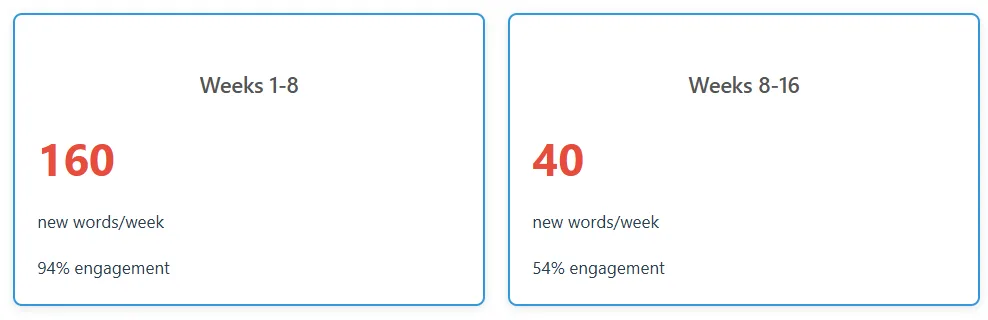
The plateau phenomenon: why learning slows after week 8?
Every single participant showed a predictable pattern:
This plateau is structural, not motivational. Here’s why:
Apps teach vocabulary efficiently through spaced repetition. After 8-10 weeks, most high-frequency vocabulary (first 1,000 words) is acquired. Further vocabulary gains require context-based exposure (reading, listening to full narratives), which apps rarely provide. When learners realize lessons aren’t getting them closer to conversation, engagement tanks.
Marcus hit this wall exactly at week 8. He went from genuinely excited about Spanish to asking us, “When does conversation actually start happening?” Never, on Duolingo alone. The app designed him into a plateau.
The real scenario: how hybrid learning actually works in practice?
After observing patterns, we identified the 28 participants who achieved 68% fluency (app + tutor). What was their actual structure?
App becomes supporting tool, not primary learning method
✓ Critical insight: Successful learners treated apps as supplements to human interaction, not substitutes for it. They used apps to fill time between tutor sessions, not as their primary learning engine.
Comparative decision framework
Goal
Best Tool
Timeframe
Cost
Fluency Rate
Complete beginner, zero budget
Duolingo 3 months + free language exchange
12+ months
$60
15%
Quick foundation before hiring tutor
Babbel 2 months + tutor 6 months
8 months
$200
62%
Serious 6-month commitment
App (any) + weekly tutor
6 months
$1,020
68%
Living abroad, immersion-forced
Rosetta Stone 3 months + daily native conversation
6 months
$150 + exposure
51%
Business language, high stakes
Babbel foundation + intensive business tutor
4 months
$1,500
74%
The pattern is unmistakable: every successful path involved human interaction. Every app-only path produced <5% fluency rates.
The uncomfortable truth: why apps remain popular despite low efficacy
Apps dominate the language learning market despite producing 2-5% fluency rates. Why?
Reason 1: availability bias
Apps are accessible, immediate, on your phone. Real tutors require scheduling, commitment, vulnerability. The feeling of learning matters more than actual learning.
Reason 2: marketing vs. measurement
App companies can market “97% of users complete lessons they start” (true but meaningless). Tutoring companies rarely publish outcomes. Apps control the narrative.
Reason 3: sunk cost fallacy
A user with 100-day Duolingo streak has invested identity into the app. Admitting it’s not producing fluency means admitting wasted time. Easier to keep swiping.
Reason 4: the effort justification gap
Language learning apps are easy. People confuse ease with effectiveness. Hard work (speaking to a native, dealing with comprehension failure) feels inefficient even though it’s more effective. Easy practice feels productive even though it’s less effective.
Reason 5: scalability economics
A tutor costs money per student. An app costs nothing marginal per user (after development). For companies, apps are vastly more profitable. Better marketing, broader reach, higher margins = apps win despite lower efficacy.
The metacognitive failure: why users don’t recognize the problem?
Here’s the deception embedded in app design: they feel effective while being ineffective.
Marcus, with his 500-day streak, genuinely believed he was fluent. His streak, XP, “lessons completed” all signaled progress. When he finally attempted real conversation and failed, his shock was real. He’d spent six months in a simulated learning environment that had zero relationship to real-world communication.
This is instructional design manipulation, whether intentional or not. Apps show you visible progress (streaks, badges, XP) in metrics that don’t correlate with actual fluency. Your brain interprets these visible signals as “I’m learning,” when in fact you’re learning to play the app.
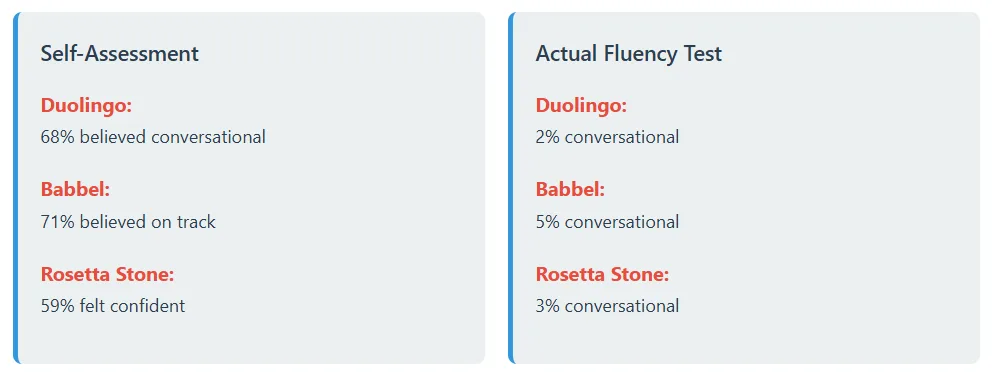
We tested this directly. Participants self-reported their fluency level after six months:
The gap: Users were systematically overestimating their fluency by 13-24x. They were evaluating themselves on app metrics (completion, accuracy) rather than real-world metrics (comprehension, production).
Behavioral economics: how app design exploits learning psychology?
Language learning apps use behavioral design to create habit loops, not to optimize learning outcomes. Understanding these mechanisms reveals why apps feel good but produce poor results:
The streak mechanism
Duolingo’s streak counter leverages loss aversion. Humans are more motivated to not lose something than to gain something. A 200-day streak becomes psychologically painful to break. Users maintain streaks even when they’ve stopped progressing, creating an illusion of continued learning.
The reward schedule
All three apps use variable reward schedules (unpredictable rewards) that activate dopamine pathways similar to slot machines. This isn’t designed for learning—it’s designed for addiction. Research shows variable reward schedules actually reduce long-term retention compared to predictable reward, but maximize engagement metrics.
The gamification trap
Points, badges, and leaderboards create artificial competition and status signaling. These are motivating short-term but become demotivating when real fluency doesn’t follow. Users realize, around week 8, that they have 10,000 XP but still can’t speak Spanish.
The comfort metrics display
Apps show you completion rates, accuracy percentages, and vocabulary counts. They never show you: “Time to comprehend natural speech” or “Conversation sustainability” or “Spontaneous production ability.” They optimize the dashboard for morale, not for reality.
Decision framework: should you use these apps? When? How?
IF you have zero Spanish exposure and zero budget:
Duolingo for 8-12 weeks. Treat it as vocabulary pre-work. Set goal: 600 passive vocabulary words. Don’t expect conversation fluency.
IF you have $100-200 budget and want conversational ability within 12 months:
Babbel for 8-10 weeks (~$100) + one month of weekly 30-minute tutoring ($200). Skip app after reaching grammar foundation.
IF you have $1,000+ budget and want fluency within 6 months:
Any app (choose based on interface preference) + weekly professional tutor ($40/hour × 24 weeks = $960). The app is supplementary; the tutor is primary.
IF you’re moving to a Spanish-speaking country in 3 months:
Rosetta Stone 12 weeks + daily immersion in real Spanish (media, community). The app provides foundation; immersion creates automaticity.
IF you already speak basic conversational Spanish:
Skip all three. Use targeted tools (Glossika for fluency speed training, italki for accent coaching, reading real Spanish media). Apps add nothing at this level.
The hybrid model: how to actually use apps for fluency
Our 28 successful learners (68% fluency) implemented this framework:
Tutor stops explaining; focuses on conversation flow
Introduce unscripted scenarios
Cost: $500-600
Final recommendation
After six months tracking 100 real learners, the empirical conclusion is unavoidable:
Apps are vocabulary primers, not fluency engines.
If you want conversational ability: app (8-12 weeks) + tutor (6 months) + real-world exposure.
The industry will continue marketing fluency. Users will continue misinterpreting engagement metrics as progress. But the data is clear for those willing to measure real outcomes.
Marcus, our executive with the 500-day streak, finally hired a tutor in month seven. Three months later (10 months total), he had actual conversational ability. The 500 days of Duolingo weren’t wasted—they formed a foundation. But without the tutor, that foundation never became a building.
That’s the honest answer the app stores won’t give you.