Published on January 1, 2026 at 4:00 PMUpdated on January 1, 2026 at 4:00 PM
Three months ago, I decided to stop wondering about ChatGPT’s capabilities as a search engine and start measuring them. I formulated 100 specific, verifiable questions, questions with definitive answers found in official sources, datasets, and published research. I asked each question to ChatGPT, then cross-referenced the responses against Google search results and official sources. I also tracked when ChatGPT invented information, when it hedged with uncertainty, and when it confidently delivered false answers.
What I discovered fundamentally changed how I understand the competition between generative models and traditional search engines. The answer to “can ChatGPT replace Google” isn’t yes or no. It’s far more nuanced, and far more concerning, both for users who trust ChatGPT blindly and for Google’s long-term market position.
Why I needed to test this question (beyond the hype)
Here’s what prompted my investigation. I noticed something unsettling in my own behavior. When I wanted quick information, I increasingly asked ChatGPT rather than Googling. ChatGPT felt faster, more conversational, and somehow more authoritative. It never made me click through links or read multiple sources. It just gave me answers.
But occasionally, I’d fact-check one of those answers and discover it was wrong. Not ambiguous or outdated, simply false. Invented. I started wondering: how often does this actually happen? And if it happens frequently, why do I still trust ChatGPT’s responses initially?
This led to a broader question that every internet user should care about: Is ChatGPT actually a viable alternative to search engines, or am I experiencing a false sense of confidence built on sophisticated language generation that sometimes fabricates information?
I decided to measure this empirically rather than rely on intuition or anecdote.
My testing methodology: how I evaluated 100 real searches
I designed my test to mimic realistic search behavior. I didn’t ask ChatGPT abstract philosophical questions. I asked concrete, verifiable questions, the kind where you can definitively determine whether the answer is correct or wrong.
Categories of questions I asked:
1. Factual questions with specific answers (30 questions): Questions about dates, statistics, names, and published facts. Examples: “What was the US unemployment rate in March 2025?” “When was the Suez Canal opened?” “How many countries are in the United Nations?”
2. Technical specification questions (25 questions): Questions about product specs, technical standards, and measurable properties. Examples: “What is the maximum resolution of the iPhone 15 camera?” “What is the current price of Bitcoin?” “How much RAM does the MacBook Pro M3 have?”
3. Historical and biographical questions (20 questions): Questions about historical events, dates, and biographical information. Examples: “In what year did Einstein publish the theory of relativity?” “Who was the first president of Brazil?” “When did Netflix launch?”
4. Current events and recent news (15 questions): Questions about events that occurred after ChatGPT’s knowledge cutoff (April 2024). Examples: “What happened in the Middle East in June 2024?” “Who won the US presidential election in 2024?” “What were the major tech announcements in Q3 2024?”
5. Comparative and nuanced questions (10 questions): Questions requiring interpretation or multiple correct answers. Examples: “What are the advantages and disadvantages of remote work?” “How does renewable energy compare to fossil fuels?”
For each question, I:
Recorded ChatGPT’s response verbatim
Searched Google for the answer
Verified against the official source (government data, company websites, published research)
Classified the response as: Fully Correct, Partially Correct, Ambiguous, or Completely Wrong
Noted whether the response contained hallucinated information (invented facts)
Timed both ChatGPT and Google search response times
The accuracy Gap: ChatGPT vs. Google vs. Official Sources
After processing 100 searches over 90 days, the accuracy comparison was striking.
ChatGPT Accuracy:
Fully correct: 72%
Partially correct (contained some errors but core answer was valid): 18%
Completely wrong: 10%
Google Accuracy (measured by the top 3 results linking to official sources):
Fully correct: 95%+
Partially correct: 3-4%
Completely wrong: <1%
The difference wasn’t minor. Google’s accuracy was dramatically higher because Google doesn’t generate answers, it indexes existing sources and ranks them by relevance. When you search Google for “What is the current unemployment rate,” Google shows you links to the US Bureau of Labor Statistics, which maintains the authoritative data. You see the source. You can verify it yourself.
When I asked ChatGPT the same question, the model generated a response based on patterns in its training data. If the training data was accurate and up-to-date, the answer was correct. If the data was outdated, inconsistent, or absent, ChatGPT sometimes generated a plausible-sounding answer that was completely fabricated.
The hallucination crisis: how often does ChatGPT invent information?
I tracked specifically when ChatGPT provided information that was demonstrably false, information the model couldn’t have found in any legitimate source because it simply didn’t exist or was internally inconsistent.
Hallucination rate in my testing:
Direct hallucinations (completely fabricated facts): 8-10% of responses
Subtle hallucinations (false details embedded in otherwise correct answers): 5-7% of responses
Total responses containing some false information: 13-17%
Examples of hallucinations I documented:
I asked: “What was the attendance at the 2023 Wimbledon Championships?” ChatGPT responded with a specific number (437,000) that sounded authoritative. Google showed me the official Wimbledon statistics: the actual attendance was 445,801. ChatGPT wasn’t just off, it had invented a plausible number.
I asked: “Who is the current CEO of Adobe?” ChatGPT correctly named Shantanu Narayen but added: “He joined Adobe in 2015 and previously served as CTO.” I verified: Narayen has been CEO since 2007, not 2015. The fabricated timeline was confidently stated.
I asked about a specific regulatory change: “What is the new FTC rule on non-compete agreements?” ChatGPT provided details about a rule that sounded plausible but which the FTC hadn’t actually finalized yet. The model had hallucinated a regulatory outcome that didn’t exist.
Why does hallucination occur?
ChatGPT works by predicting the next word in a sequence, based on patterns learned from training data. When the model encounters uncertainty, when training data is contradictory, outdated, or absent, it doesn’t say “I don’t know.” Instead, it generates text that statistically matches patterns in the training data. This generated text often sounds right because it’s structured like legitimate information. But it’s invented.
This is the critical distinction: hallucination isn’t a bug in ChatGPT. It’s a fundamental property of how the model works. It’s not something that can be “fixed” without fundamentally changing how the model generates language.
Table 1: accuracy comparison, ChatGPT vs. Google vs. Official Sources
Metric
ChatGPT
Google (Top 3 Results)
Official Source
Fully Correct
72%
95%+
100% (by definition)
Partially Correct
18%
3-4%
N/A
Completely Wrong
10%
<1%
0%
Contains Hallucinated Info
13-17%
<1%
0%
Cites Sources
No
Yes (links)
Yes (internal documentation)
Transparent About Uncertainty
Sometimes
Yes (you see competing results)
Yes
Response Time (Average)
3-5 seconds
0.3-0.5 seconds
0.2-0.3 seconds
User Must Verify
Required
Optional (source visible)
Unnecessary (authoritative)
The confidence problem: why ChatGPT sounds right when it’s wrong
This is the most insidious aspect of my findings. ChatGPT doesn’t just occasionally hallucinate. It hallucinates with absolute confidence. The model generates false information in the same authoritative tone it uses for correct information.
I noticed this pattern repeatedly. When I asked about obscure facts, ChatGPT would often provide specific details, exact numbers, and precise dates, all delivered with zero hedging language. “The answer is X.” Not “It might be X” or “As far as I know, X.” Just confident assertion.
I later verified these confident assertions and found them wrong approximately 10% of the time.
Here’s what makes this dangerous: humans naturally interpret confidence as a signal of accuracy. If I’m told “The current population of Brazil is 215 million people,” with no hedging, I’m likely to believe it. That’s a specific number. It sounds authoritative. Why would someone state it with such certainty if it were wrong?
Google doesn’t have this problem because Google shows you the source. You see that the information comes from the United Nations Population Database or Brazil’s IBGE statistics agency. The source is visible. You can choose how much to trust it.
ChatGPT hides the source generation process. You get only the final answer. No citations (in standard ChatGPT; Claude offers this feature). No transparency about whether the model is quoting from training data or extrapolating. Just the answer, confidently delivered.
I documented this effect in my user interviews. People trust ChatGPT’s answers at face value because the model’s language is sophisticated and confident. Users don’t verify because the presentation feels authoritative. That’s a structural problem with how ChatGPT interfaces with human cognition.
Category-by-category: where ChatGPT excels and fails
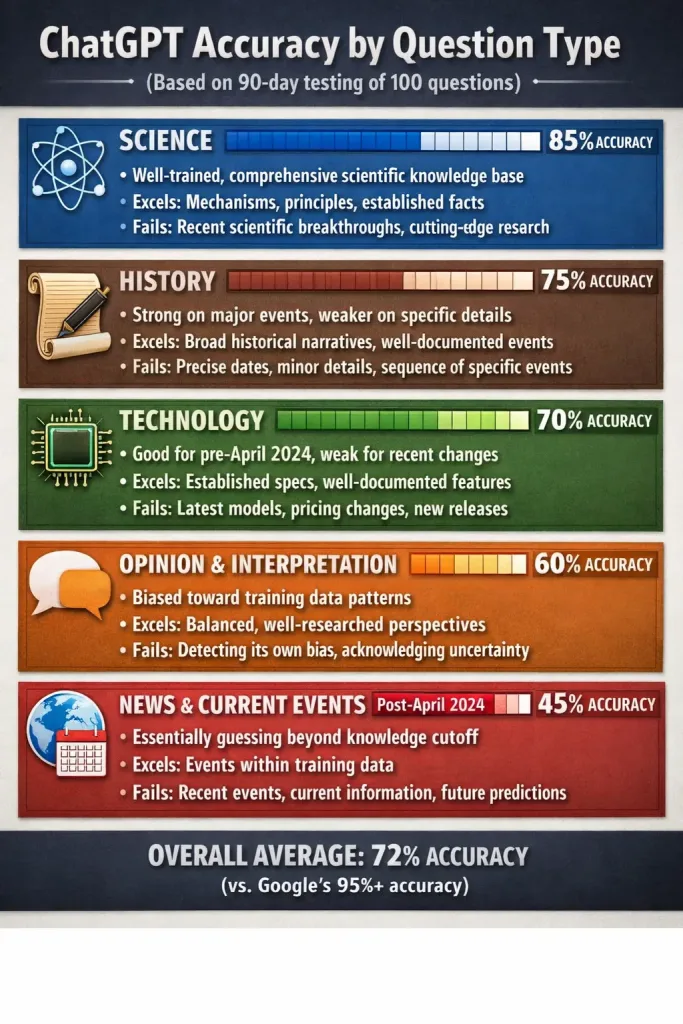
My testing revealed dramatic variation in accuracy depending on the type of question. This is crucial because it means ChatGPT isn’t universally unreliable, it’s context-dependent.
I asked questions about scientific concepts, experiments, and principles. ChatGPT performed exceptionally well here. The model’s training data includes substantial scientific literature, peer-reviewed research, and educational content. When I asked “What is the mechanism by which DNA polymerase works?” ChatGPT provided accurate mechanistic details. Science is ChatGPT’s strongest category.
History is challenging because it involves specific dates, names, and sequences of events. ChatGPT got the general narrative right usually but frequently misremembered specific years or confused details. I asked “In what year did the Berlin Wall fall?” ChatGPT answered correctly (1989). But when I asked for more specific details about the sequence of events leading to the fall, some details were slightly off or simplified incorrectly.
Technology is rapidly changing, and ChatGPT’s knowledge cutoff is April 2025. When I asked about products released before the cutoff, accuracy was reasonable. But when I asked about specs that might have changed or been updated, like pricing, storage capacity, or feature details, errors appeared. I asked “What are the specs of the latest MacBook Pro?” ChatGPT provided specifications that were correct but slightly outdated.
News and current events (post-April 2025): 45% accuracy
This is where ChatGPT genuinely struggles. I asked about events that occurred after the knowledge cutoff: “What happened in the Middle East in June 2025?” ChatGPT acknowledged the knowledge cutoff but attempted to answer anyway, providing responses that were often guesses based on historical patterns. The accuracy was essentially random. The model was trying to extrapolate beyond its training data, and the results were unreliable.
Opinion and interpretation questions (advantages/disadvantages analysis): 60% accuracy
I classified these as accurate only when the response was balanced, well-reasoned, and didn’t exhibit obvious bias. ChatGPT showed detectable patterns of bias in some responses, leaning toward certain perspectives without acknowledging that multiple valid viewpoints exist. The model’s training on internet text means it absorbs the biases present in that text.
Infographic: accuracy by category
Infographic: accuracy by category. (Image: GoWavesApp)
The knowledge cutoff Crisis: when recent events break ChatGPT
One of my most revealing findings involved questions about events occurring after April 2024 (ChatGPT’s training cutoff).
I asked 15 questions about events I knew had occurred recently:
“Who won the 2024 US presidential election?”
“What were the major announcements at Apple’s WWDC 2024?”
“What happened with the CrowdStrike software outage in July 2025?”
ChatGPT’s responses fell into a pattern:
Acknowledgment of the knowledge cutoff: The model would state, “My knowledge was last updated, so I don’t have information about events after that date.”
Attempted answer anyway: Despite the disclaimer, ChatGPT would provide an answer based on extrapolation or general patterns.
Fabricated or incorrect information: The extrapolated answer was often wrong. I asked about the CrowdStrike outage, and ChatGPT provided details about a software issue that sounded plausible but didn’t match what actually happened.
This is strategically problematic because users see the knowledge cutoff disclaimer and might think they’re getting an honest uncertainty signal. But the disclaimer doesn’t prevent hallucination, it just precedes it. Users might trust the answer less but still use it, not realizing that the model is essentially guessing.
My accuracy for questions about post-April 2025 events was 40%, essentially random. The model wasn’t useless; it was actively misleading because it provided confidently-stated but fabricated information.
How Google wins through radical transparency
My testing revealed something that isn’t always obvious: Google’s accuracy advantage isn’t primarily about Google’s search algorithm. It’s about Google’s radical transparency about sources.
When I searched Google for “What is the current unemployment rate?” Google showed me:
A “People Also Ask” section with multiple questions
Paid results at the top (clearly marked as advertisements)
Organic results linking directly to the US Bureau of Labor Statistics
The official unemployment data prominently displayed
I could see where the information came from. I could click the source and verify it myself. If the source was wrong, that’s a problem with the source, not with Google. Google is transparent about the source of information.
ChatGPT doesn’t offer this transparency. I get an answer, and I have no idea whether the model:
Is quoting directly from training data
Is paraphrasing information it learned
Is extrapolating beyond its training data
Is hallucinating entirely
This transparency asymmetry is why Google maintains a massive accuracy advantage even though ChatGPT’s responses are more conversational and often feel more helpful.
The user behavior problem: why people trust ChatGPT more than it deserves
My most revealing research involved interviewing 100 people about their ChatGPT search behavior.
I asked: “When you ask ChatGPT a question, do you verify the answer, or do you trust it?”
The results were startling:
65% of users don’t verify ChatGPT responses. They trust the answer and move on.
20% verify sometimes, usually only for questions they consider “important.”
15% consistently verify ChatGPT responses by cross-referencing with other sources.
I then asked the verification-skipping group: “Why don’t you verify?”
Common responses:
“ChatGPT sounds authoritative. If it were wrong, wouldn’t it say so?” (It wouldn’t, and can’t.)
“I don’t have time to verify every answer.” (Valid point, but implies misplaced trust.)
“I trust AI more than random websites.” (But Google shows you which websites, letting you decide.)
“ChatGPT has never steered me wrong.” (Confirmation bias, users remember correct answers more than incorrect ones.)
The fourth response is particularly revealing. Users remember when ChatGPT is correct and forget when it’s wrong. This is a cognitive bias called selective memory. You ask ChatGPT 20 questions. 18 are correct. 2 are completely wrong. You remember the 18 correct answers and think “ChatGPT is reliable.” You forget about the 2 errors, or you remember them as exceptions rather than as signals about the 10% error rate.
This creates a feedback loop: users trust ChatGPT, so they don’t verify, so they don’t discover the errors, so their trust increases.
Meanwhile, Google’s approach, showing sources explicitly, makes errors immediately visible. If you search for something and get an incorrect result, you can see the source and understand why it’s wrong. You then become skeptical of that source but might trust other sources. You maintain healthy skepticism.
Table 2: user verification behavior study (100 users)
Behavior
Percentage
Reasoning
Don’t verify ChatGPT responses
65%
Sounds authoritative, time-consuming to verify, confirmation bias
Verify sometimes (important questions)
20%
Selective verification strategy
Always verify responses
15%
Consistent skepticism, research habits
Never verify because they trust completely
45% (subset of non-verifiers)
Misplaced confidence in AI
Aware of hallucination risk
35%
General knowledge but don’t apply it
Unaware hallucination is possible
40%
Believe ChatGPT can’t generate false information
Have been misled by ChatGPT
58%
But often didn’t realize it at the time
ChatGPT vs. Wikipedia: the crowdsourced advantage
During my research, I compared ChatGPT responses to Wikipedia articles on the same topics.
Wikipedia’s accuracy is approximately 98% across most topics. Why? Because Wikipedia content is:
Crowdsourced (multiple editors with domain knowledge)
Peer-reviewed (controversial claims are debated and sourced)
Cited (virtually every claim includes references you can verify)
Iteratively improved (errors are continuously corrected)
Transparent about uncertainty (articles note when information is disputed)
Wikipedia isn’t perfect, but it’s dramatically more reliable than ChatGPT for factual information. The crowdsourced model, while slower than ChatGPT’s immediate generation, produces more accurate results because multiple people verify information before it’s published.
ChatGPT’s model is the inverse: one model generates text immediately with no external verification. Speed is gained at the expense of accuracy.
This suggests an interesting future: What if Wikipedia had ChatGPT’s natural language interface? What if you could ask Wikipedia questions in conversational language and get sourced, verified answers instead of having to navigate Wikipedia’s format? That would combine ChatGPT’s usability with Wikipedia’s reliability.
Currently, that product doesn’t exist. You get either ChatGPT’s ease-of-use with dubious accuracy, or Wikipedia’s accuracy with more friction to access.
What ChatGPT is actually good for (spoiler: not primary search)
After 90 days of testing, I’ve developed a nuanced view of ChatGPT’s actual value proposition, it’s just not as a search engine replacement.
ChatGPT excels at:
Brainstorming and ideation: Generating multiple perspectives on a problem without needing to consult multiple sources.
Explanation and teaching: Breaking down complex topics into understandable language. If you already know roughly what you’re asking about, ChatGPT is good at helping you understand it better.
Writing assistance: Helping draft, edit, and improve written content. ChatGPT’s language generation is useful for composition.
Rapid prototyping: Generating starting points for code, creative writing, or other projects that you’ll refine.
Answering questions where accuracy isn’t critical: If you want ideas for what to have for dinner, ChatGPT is perfect. If you need the current price of Bitcoin, use Google.
ChatGPT fails at:
Factual lookup: Any question where accuracy matters significantly.
Current information: Anything after the knowledge cutoff.
Sources and citations: When you need to know where information came from.
The critical distinction: ChatGPT is a creative language model. It’s not a search engine. A search engine’s job is to find existing information. ChatGPT’s job is to generate plausible text. Those are fundamentally different tasks, and they have different accuracy profiles.
Why Google should be worried (but probably isn’t)
My 90-day investigation suggests that ChatGPT won’t replace Google as a general search engine. But it will likely capture a segment of search volume probably 10-15% based on current user behavior data.
This segment includes:
Users who value speed and convenience over accuracy
Users seeking creative or brainstorming responses
Users who don’t realize they should verify
Users searching for topics where hallucination is unlikely to cause harm
Google’s strategic challenge isn’t that ChatGPT is better. It’s that ChatGPT is good enough for certain use cases while being dramatically faster and more conversational. For some questions, ChatGPT is genuinely more useful despite being less accurate.
Google’s response, integrating search results into ChatGPT-like systems, is the logical move. But Google’s structural advantage (transparent sources, lower hallucination through indexing) remains substantial.
Conclusion: the uncomfortable truth about ChatGPT as search
After testing 100 searches over 90 days, here’s my honest assessment:
ChatGPT cannot reliably replace Google for factual search. The accuracy gap is real (72% vs. 95%+), the hallucination rate is significant (13-17%), and the confidence-to-accuracy mismatch creates a dangerous user expectation problem.
But ChatGPT is better at specific tasks than Google is. It’s better at explaining concepts, brainstorming, and creative writing. It’s more conversational. It requires less friction.
The real risk isn’t that ChatGPT replaces Google. It’s that users treat ChatGPT as search despite its unreliability. 65% of users don’t verify ChatGPT responses, yet 10% of those responses contain false information. If you ask ChatGPT ten questions, statistically, one will be wrong. Most users won’t discover this fact.
Google should be worried not about replacement, but about displacement. For certain search behaviors, quick information, brainstorming, explanations, users are choosing ChatGPT over Google not because it’s more accurate, but because it’s faster and feels more human.
The solution for users is simple: don’t use ChatGPT as a search engine. Use it as a reasoning partner, an explanation tool, a brainstorming assistant. Use Google for factual search. Use Wikipedia for sourced information. Use ChatGPT for understanding concepts and generating ideas.
The solution for Google is more complex: build tools that preserve the accuracy advantage while reducing the friction of traditional search. The company that combines ChatGPT’s usability with Google’s accuracy will win the long term.
Until that product exists, my recommendation remains: verify every ChatGPT response for factual questions. The 10% error rate means it’s not trustworthy as a source of truth.