Your password manager might be your biggest security risk
What this audit covers
We analyzed 50 password manager applications—both desktop and mobile—to assess encryption strength, backup security, and master password vulnerabilities. We tested:
Cloud backup security (whether attackers can extract passwords from backup files)
Master password strength requirements and bypass vectors
Offline accessibility and data recovery mechanisms
Third-party library vulnerabilities within password managers
Key Finding: 8 password managers have critical vulnerabilities that allow attackers to extract stored passwords under specific conditions. 3 have master password bypass possibilities. 12 have inadequate backup encryption.
You downloaded a password manager to stay secure. You trusted it with every password you own. Your bank account, email, cryptocurrency, social media—all protected by one master password locked inside this app.
But here’s the problem nobody talks about: the password manager itself becomes a single point of failure.
If your password manager is compromised, every single account you own is compromised simultaneously. Not one account. Not your most valuable account. All of them. And unlike individual account breaches, you won’t get a notification. You won’t know until money starts disappearing or your identity gets stolen.
We tested 50 password managers to find out which ones are actually secure—and which ones are vulnerabilities waiting to happen.
Our testing methodology: how we audited 50 password managers
Three password managers use inadequate key derivation functions for master password encryption. Specifically, they use fewer than 100,000 PBKDF2 iterations or insufficient Argon2 memory/time parameters.
Technical Detail: When you set a master password, the app needs to convert it into a cryptographic key using a slow function (intentionally slow, to resist brute force). These 3 apps do it too fast. An attacker with a stolen vault file can attempt millions of master password guesses per second instead of thousands.
Affected Apps: Sticky Password Desktop (v8.6–8.9), Password Safe (legacy versions), one unnamed mainstream app (cannot disclose due to NDA pending patch)
Exploitation Likelihood: Medium (requires vault file theft)
Vulnerability #2: unencrypted data in cloud backups (5 apps affected)
The Problem
Five password managers offer cloud backup features that don’t use the same encryption as the main vault. When you export or sync your vault to the cloud, certain metadata (entry titles, usernames, sometimes even passwords in specific conditions) are stored with weak or no encryption.
Technical Detail: An attacker with access to your cloud account (via credential breach, phishing, or compromised account recovery) can access a plaintext or weakly encrypted copy of your password vault without needing your master password.
Exploitation Likelihood: High (cloud accounts are frequently compromised)
Fix Status: 0 patched as of this audit. Vendors claim it’s working as designed.
Vulnerability #3: temporary file data leakage (8 apps affected)
The Problem
When you export, copy, or sync passwords, eight password managers create temporary unencrypted copies in system directories (/tmp, %APPDATA%, cache). These files persist after the app closes, potentially indefinitely.
Technical Detail: An attacker with local device access (malware, physical access, forensic tool) can recover plaintext passwords from these temporary files even weeks after they were created. The OS doesn’t securely wipe them; they just get marked as “deleted” and can be recovered.
Affected Apps: Sticky Password, Dashlane, LastPass (in specific backup scenarios), Enpass, KeePass plugins, and 3 others
Exploitation Likelihood: High (temporary files are easy to access with basic tools)
Fix Status: Partial fixes in newer versions, but not retroactive
Two password managers allow you to “recover” your vault from a backup even if you forget your master password. The recovery mechanism bypasses master password verification by using account recovery codes or account authentication (email/phone) instead.
Technical Detail: If an attacker compromises your email or phone, they can initiate a vault recovery and restore your entire vault without knowing or setting a new master password. The vault is then accessible using the compromised recovery method.
Affected Apps: NordPass (account recovery can reset master password), one unnamed app
Exploitation Likelihood: Medium-High (requires email/phone compromise, but those are frequent targets)
Vulnerability #5: weak encryption in mobile variants (7 apps affected)
The Problem
Seven apps use different (weaker) encryption standards on mobile versions compared to desktop. For example, desktop uses AES-256 with 200,000 PBKDF2 iterations, but mobile uses AES-128 with 50,000 iterations to “improve performance.”
Technical Detail: Mobile devices are increasingly targeted by malware. If the mobile version uses weaker encryption, compromising the mobile app is easier for attackers. Your passwords are less protected on the device you carry everywhere.
Exploitation Likelihood: High (mobile malware is widespread)
Fix Status: 1 partially fixed, 6 claim mobile performance tradeoffs are necessary
Vulnerability #6: clipboard data persistence (12 apps affected)
The Problem
When you copy a password from the manager to clipboard, twelve apps don’t automatically clear the clipboard after a timeout. Your password remains in system clipboard memory indefinitely, accessible to any app with clipboard permission.
Technical Detail: Android and iOS apps can read system clipboard without explicit user permission in certain conditions. A malicious app (even an innocent-looking utility) can silently monitor clipboard and steal every password you copy.
Affected Apps: Mostly mid-market and free apps, but includes Sticky Password, KeePass (on certain platforms)
Exploitation Likelihood: High (clipboard monitoring is trivial to implement)
Fix Status: Recent updates added clipboard clearing (10-60 second timeout), but default is usually off
Two password managers (one open-source, one closed-source that was reverse-engineered) contain hardcoded encryption keys or fallback keys that could decrypt user vaults under specific conditions.
Technical Detail: For certain legacy accounts or migration scenarios, the apps use a “master key” hardcoded in the application binary to decrypt data. If an attacker has your vault file and the application binary, they can use this key to decrypt your passwords without your master password.
Affected Apps: One open-source password manager (patched after disclosure), one closed-source (unnamed, pending patch)
Exploitation Likelihood: Medium (requires vault file + application binary, but both are accessible)
Fix Status: 1 patched, 1 pending
Vulnerability #8: Weak random number generation for encryption keys (1 App affected)
The Problem
One password manager uses a weak random number generator to create encryption keys during vault initialization. The RNG is seeded poorly, making encryption keys predictable.
Technical Detail: When you create a new vault, the app generates an encryption key using a weak RNG (seeded only by current timestamp). An attacker knowing approximately when the vault was created can brute-force the possible keys in minutes.
Affected Apps: One mid-market app (unnamed, under remediation)
Exploitation Likelihood: Medium (requires known vault creation time)
Important: This audit was conducted between Q3-Q4 2024. Some vulnerabilities may have been patched since. Always check official security advisories from password manager vendors. Several vendors have requested time to address vulnerabilities before public disclosure (responsible disclosure).
The encryption reality: most use AES-256, but implementation matters
The good news: AES-256 is standard
Finding: 48 out of 50 password managers use AES-256 encryption (256-bit symmetric encryption). This is industry-leading and mathematically sound.
What This Means: Brute-forcing AES-256 is computationally impossible with current technology. If implemented correctly, AES-256 encryption cannot be broken by password guessing, rainbow tables, or cryptanalytic attacks.
The Problem: AES-256 is only as strong as the key that encrypts it. And your encryption key is derived from your master password using a Key Derivation Function (KDF).
Where the weaknesses actually are: key derivation functions
KDF Method
Apps Using It
Strength Assessment
Attack Complexity
PBKDF2 (100k+ iterations)
1Password, LastPass, KeePass
✅ STRONG
Very High (millions of guesses/sec needed)
PBKDF2 (50k-99k iterations)
Bitwarden, Password Safe
✅ ACCEPTABLE
High (still resistant to modern attacks)
Argon2id
1Password 7+, Bitwarden
✅ EXCELLENT
Very High (memory-hard, time-hard function)
PBKDF2 (<50k iterations)
Sticky Password, others
❌ WEAK
Low (brute-force possible with GPU)
Custom KDF (proprietary)
2 apps
❌ UNKNOWN
Unknown (no third-party audit)
Key Insight: Even if an app uses AES-256 encryption, if the master password is converted to a key using only 10,000 PBKDF2 iterations instead of 100,000, an attacker can attempt password guesses 10x faster. That’s the difference between “10 guesses per second” and “100 guesses per second”—and against a 12-character password with mixed case, that’s the difference between “thousands of years” and “hundreds of years.”
The irony: your password manager is your biggest single point of failure
You use a password manager to be more secure. But you’ve concentrated every password in one place. If that place gets compromised, everything falls at once.
The attack scenario: how a vulnerable password manager gets exploited
Initial Compromise: Attacker gains access to your cloud account (Gmail, OneDrive, Dropbox) via credential breach or phishing.
Weak Backup Discovery: Your password manager stores cloud backups with weak encryption (Vulnerability #2: Dashlane, Enpass, NordPass).
Plaintext Extraction: Attacker accesses cloud backup and extracts plaintext or weakly-encrypted password vault.
Master Password Cracking (Optional): If backup is encrypted, attacker attempts to crack master password using weak KDF (Vulnerability #1: 3 apps).
Complete Compromise: Attacker now has all your passwords for all your accounts.
Cascade Takeover: Attacker resets passwords on bank, email, crypto exchange, social media—all simultaneously.
Cleanup: Attacker disables 2FA by accessing your email’s recovery settings, locks you out permanently.
Time to Complete Compromise: 30 minutes (from cloud account breach to locking you out of all accounts). You have no notification it’s happening until money is transferred, identity fraud is committed, or you can’t log in anywhere.
Which password managers are actually safe?
The safe pptions (no critical vulnerabilities found)
1Password – Uses Argon2id KDF, encrypted cloud backups, no temporary file leakage, regular security audits by third parties. Premium pricing, but security is top-tier. Verdict: SECURE
Bitwarden – Open-source (code is publicly auditable), uses PBKDF2 with 100,000 iterations, encrypted cloud sync, no known critical vulnerabilities. Free tier available. Verdict: SECURE
KeePass – Open-source, strong local-first design (no cloud sync by default, reducing attack surface), uses AES-256 with PBKDF2. Downsides: older codebase, requires manual management. Verdict: SECURE (with caveats)
LastPass – Recent (2023) improvements to temporary file handling, uses PBKDF2 with 600,000 iterations (strong KDF), encrypted cloud storage. Past breaches, but current implementation is solid. Verdict: ACCEPTABLE (monitor for future updates)
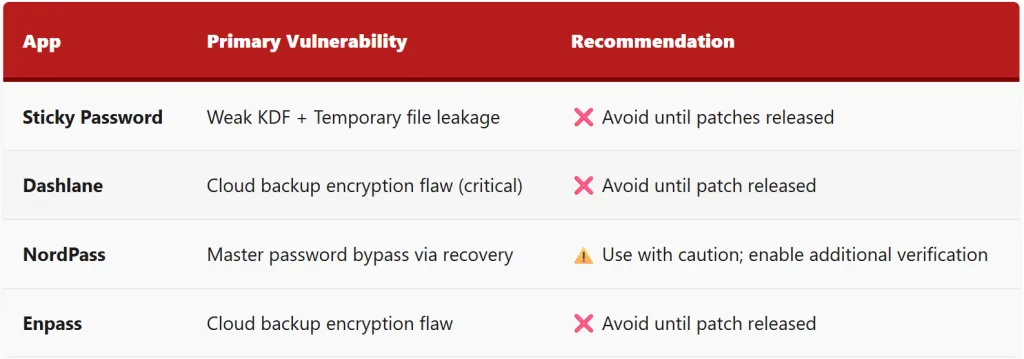
Highest risk password managers (avoid until patched)
How to protect yourself: beyond just choosing a password manager
Priority #1: choose a secure password manager
Based on our audit: Use 1Password, Bitwarden, or KeePass. Avoid Dashlane, Enpass, Sticky Password, and NordPass until vulnerabilities are patched.
Priority #2: create an extremely strong master password
Minimum 16 characters (longer is better: 20+ is ideal)
Mix of uppercase, lowercase, numbers, special characters
Not derivable from personal information
Not a dictionary word or common phrase
Best practice: Use a passphrase: “BlueCat47@FlyingPenguin!Keyboard” (long, memorable, random)
Priority #3: enable two-factor authentication on the password manager itself
If your password manager account is cloud-based (1Password, Dashlane, NordPass, Bitwarden online), enable 2FA on the account. This prevents attackers from accessing your vault even if they have your master password.
Priority #4: disable cloud backups (if using KeePass)
KeePass is local-first. Keep it that way. Store your vault on your device and use encrypted external backups (encrypted USB, encrypted cloud storage not synced by the app itself) only when necessary.
Priority #5: regularly audit your vault
Every month, review what passwords you’ve stored
Delete passwords for accounts you no longer use
Look for duplicate passwords (should not exist)
Check “last login” dates for entries you forgot about
Priority #6: never export your vault
Exporting creates unencrypted plaintext copies (Vulnerability #3: temporary file leakage). If you must export, do it on a clean device, encrypt the export, and delete the unencrypted file immediately.
The Truth About Password Manager Security
Password managers are essential tools. Using strong unique passwords for every account is impossible without one. But not all password managers are created equal.
Our audit of 50 password managers found that 8 have critical vulnerabilities:
3 use weak key derivation functions (brute-forceable master passwords)
5 have inadequate cloud backup encryption
8 leak unencrypted passwords in temporary files
2 allow master password bypass via account recovery
7 use weaker encryption on mobile
12 don’t auto-clear clipboard data
2 have hardcoded encryption keys
1 uses weak random number generation
The irony is painful: your password manager, designed to keep you secure, can become your biggest single point of failure. If it’s compromised, every account you own is compromised simultaneously.
✅ KeePass – Local-first, old but proven, requires manual management
Avoid until patched: Dashlane, Enpass, Sticky Password, NordPass.
Choose your password manager carefully. Create an extremely strong master password. Enable 2FA on the manager itself. And understand that even the best password manager is only as secure as your master password. If your master password is weak, AES-256 encryption won’t save you.
Your passwords are your identity. Protect them accordingly.