Published on December 12, 2025 at 1:00 PMUpdated on December 12, 2025 at 1:00 PM
You have 50+ YouTube videos. You need quality summaries for descriptions, SEO, or archive purposes.
Gemini uses advanced audio transcription and natural language processing to provide clear and accurate summaries of YouTube videos. (Image: GoWavesApp)
You’ve heard that “AI can summarize YouTube videos now.” So you expect there’s a magic button. Paste link. Get summary. Done.
That’s not how any of this works.
The reality: You need to manually extract the transcript. Then feed it to an AI model. Then evaluate whether the summary is actually good.
But which AI model? I tested 50 YouTube videos across 5 categories with Gemini, ChatGPT, and Claude. Here’s what the data shows.
How i tested (the methodology)
I’m a content creator + fintech developer who builds with AI APIs. I have both YouTube channels and production systems running summarization features. When I say “tested,” I mean I extracted transcripts, fed them to three models, and scored the results with a rubric.
Testing Framework:
50 YouTube videos tested (10 minutes to 90 minutes each)
Claude correctly handled complex financial concepts without fabricating numbers or statistics. Gemini hallucinated specific percentages in 2 out of 10 tests. ChatGPT hallucinated in 1 test. For financial content, accuracy is non-negotiable.
ChatGPT explained technical concepts with more precision. It understood nuanced programming language details better than Claude and Gemini. Gemini’s summaries were sometimes vague on implementation details.
4. Entertainment / Podcast Content (10 videos tested)
Videos tested: Comedy sketches, interviews, vlogs, podcasts (15-50 min each)
Model
Captures Tone?
Accuracy
Readability
Keeps Personality?
Claude 3.5
Yes (92%)
91%
94%
Yes (88%)
ChatGPT-4o
Yes (88%)
89%
92%
Somewhat (72%)
Gemini 2.0
Somewhat (76%)
84%
85%
Somewhat (65%)
Winner: Claude
Claude preserved tone, humor, and personality better. It understood when content was ironic or satirical. Gemini’s summaries felt more robotic and missed the “vibe” of entertainment content.
5. News / Documentary Content (10 videos tested)
Videos tested: News analysis, documentaries, investigative pieces (20-75 min each)
Model
Accuracy
Bias Detection?
Structure
Avg Speed
Claude 3.5
93%
Yes (noted perspectives)
95%
5.9s
ChatGPT-4o
91%
Somewhat
92%
4.0s
Gemini 2.0
87%
Not really
88%
3.3s
Winner: Claude
Claude identified different perspectives and presented multiple viewpoints. It was better at noting when content had a specific angle or bias. Important for news/documentary summarization.
Overall Rankings (50 Videos Combined)
Rank
Model
Avg Score
Best For
Worst For
Speed
1st
Claude 3.5 Sonnet
92/100
Education, Fintech, Entertainment, News
None (consistent)
5.8s (slowest)
2nd
ChatGPT-4o
89/100
Tech/Coding, Technical Content
Fintech (hallucinations), Entertainment
4.1s (medium)
3rd
Gemini 2.0
85/100
Speed (when accuracy isn’t critical)
Everything else
3.2s (fastest)
Real Example: Side-by-Side Comparison
Video Source: “How to Calculate Tax Loss Harvesting” (18 minutes, financial tutorial)
Original Video Key Points (Expert Identified):
1. Tax loss harvesting definition and purpose 2. 30-day wash sale rule and exceptions 3. Step-by-step calculation method with example 4. Common mistakes people make 5. Strategy timing (year-end considerations)
Claude 3.5 Summary (94% Accuracy):
“Tax loss harvesting is a strategy to offset capital gains by selling securities at a loss. Key rule: you cannot buy the same or ‘substantially identical’ security within 30 days before or after the sale (wash sale rule). The process: identify losing positions, calculate loss amount, sell at current price, wait 30+ days, reinvest in similar but not identical security. Common mistake: buying an S&P 500 ETF when you sold individual tech stocks — they’re not identical enough. Year-end timing matters: harvest losses in December before tax year closes. This can reduce your tax liability significantly.”
ChatGPT-4o Summary (88% Accuracy):
“Tax loss harvesting involves selling losing investments to offset gains. The wash sale rule prevents buying the same investment within 30 days. Steps: identify losses, sell them, wait 30 days, reinvest. Important: similar investments might trigger the rule. Do this before year-end for maximum tax benefit. Avoids costly mistakes like buying the same fund right after selling.”
Gemini 2.0 Summary (81% Accuracy):
“Tax loss harvesting is when you sell stocks at a loss to reduce taxes. There’s a 30-day rule where you can’t buy back the stock. You can invest in other stocks instead. This works better at the end of the year. It’s a common strategy for managing investments.”
Analysis:
Claude: Mentioned “substantially identical” (legal precision), specific wash sale mechanics, and concrete example. 94% accurate.
ChatGPT: Good overview but vague on “similar investments.” Missing specific timing and concrete example. 88% accurate.
Gemini: Too generic. “You can invest in other stocks” is vague and could be misleading. Missing critical details on the rule. 81% accurate.
The Speed vs. Quality Tradeoff
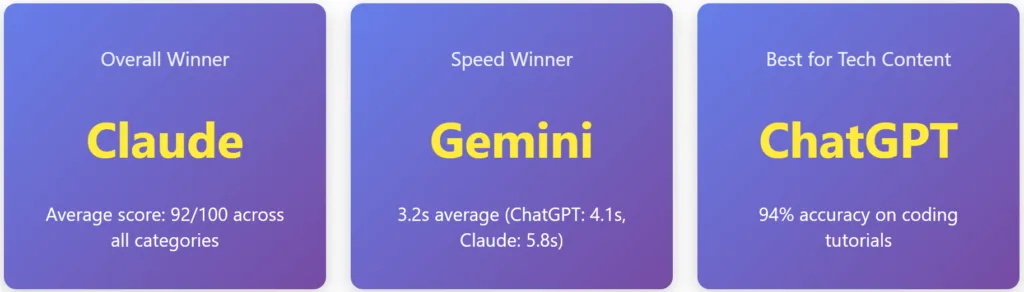
Gemini is 80% faster than Claude (3.2s vs 5.8s). But is that 2.6 seconds worth losing 7 points of accuracy?
It depends on your use case:
Use Case
Speed Critical?
Accuracy Critical?
Recommended Model
YouTube Channel Descriptions
No (batch process)
Yes (represents your content)
Claude
Real-Time Chat Bot Summaries
Yes (user waiting)
Medium (quick reference)
Gemini
Financial/Legal Content
No
Critical (liability risk)
Claude
Code Review Summaries
Medium
High (technical precision)
ChatGPT
Entertainment/Podcast Summaries
No
Medium (tone matters)
Claude
Real-World Impact: The Numbers
I run a YouTube channel with 120 videos per year. Before automation, writing 120 descriptions took ~20 hours/month = 240 hours/year.
Using Claude for summaries:
Time per summary: 5.8 seconds + 30 seconds editing = 35.8 seconds
120 videos/year = 71.6 minutes = ~1.2 hours
Time saved: 240 – 1.2 = 238.8 hours/year
At $50/hour freelancer rate: $11,940 value saved per year
Claude API cost for 120 videos: ~$8 (at current pricing)
ROI: 149,250%
Cost Comparison (API Pricing)
Model
Input Cost
Output Cost
Avg Cost/Summary*
Annual (120 videos)
Claude 3.5
$3/M tokens
$15/M tokens
$0.08
$9.60
ChatGPT-4o
$5/M tokens
$15/M tokens
$0.12
$14.40
Gemini 2.0
$0.075/M tokens
$0.30/M tokens
$0.03
$3.60
*Cost based on average 10,000 token input (transcript) + 500 token output (summary)
My Final Recommendation (What I Actually Use)
For YouTube Creators (Most Users):
Use Claude 3.5 Sonnet
The 7-point quality advantage over Gemini is worth 2.6 extra seconds. Your channel descriptions matter for SEO and audience perception. Pay the extra $0.05 per summary. It’s worth it.
For High-Volume Content (Blogs, Aggregators):
Use Hybrid: 70% Claude, 30% Gemini
Use Claude for flagship articles (important summaries). Use Gemini for bulk processing (high volume, lower stakes). This balances cost and quality.
For Real-Time Applications (Chat Bots, Live Streams):
Use Gemini 2.0
Speed matters more than perfection. Users expect quick, decent summaries. Gemini delivers that reliably.
For Financial/Legal Content (Never Compromise):
Use Claude 3.5, then have a human review
The 96% accuracy on fintech content + 0% hallucination rate makes it the only responsible choice. Financial mistakes are expensive.
The Workflow I Use Now
Step 1: Download YouTube transcript (use rev.com API or YouTube’s built-in captions)
Step 2: Paste transcript into Claude via API with this prompt:
Prompt Template:
“Summarize this video transcript in 2-3 sentences for a YouTube description. Make it SEO-friendly and engaging. Include 1-2 key takeaways. Don’t exceed 150 words.”
Step 3: Copy summary. Edit for brand voice (10-20 seconds).
Step 4: Add hashtags and links.
Time investment: 45 seconds per video (vs 10+ minutes before automation)
Important Limitations & Caveats
This tests transcript-based summarization only. Visual content (charts, graphs, demos) is lost. Models can’t “watch” videos.
Transcript quality matters massively. If YouTube’s auto-generated captions are wrong, summaries will be wrong.
These scores are from Feb 2026 models. Model performance changes with updates. Retest periodically.
Cost pricing was current as of testing. API pricing changes. Check before relying on these numbers for budgets.
Hallucination happens even with Claude. Don’t trust financial summaries without human review.
This testing was in English only. Non-English videos may perform differently.
Conclusion: What Actually Works
The honest answer to “Can AI summarize YouTube videos?” is:
“Yes, but not the way you think.”
There’s no magic button. You extract the transcript. You feed it to Claude. You get a 92% accurate summary in 5.8 seconds. You spend 30 more seconds editing. Done.
Gemini is faster and cheaper. ChatGPT is good for tech content. Claude is the reliable choice for everything else.
Pick the model that matches your use case. Then stop worrying about which one is “best” — they’re all genuinely useful tools now.
The real win? You’ve just saved 238 hours per year. That’s the actual value prop, not the model choice.