Published on November 9, 2025 at 9:00 AMUpdated on November 9, 2025 at 9:00 AM
Over the past eight weeks, we at GoWavesApp deliberately put ourselves on the front lines of the predatory ecosystem hunting young Roblox players. We didn’t theorize from a distance. We installed the malware apps ourselves. We submitted personal information to the phishing sites. We monitored fifty young players’ accounts for compromise. We tracked where their harvested data flows to data brokers and criminals.
Getting free Robux, the virtual currency in Roblox, is possible by using official and safe methods. (Image: GoWavesApp)
We did this because young players deserve to know what they’re walking into when they click “free Robux” on YouTube. And parents deserve to understand exactly how their children are being targeted for data extraction.
What we discovered is systemically troubling:
87% of the “free Robux” methods we tested are designed to extract personal data or compromise accounts
65% of these scams violate COPPA regulations by collecting information from children under 13 without parental consent
43% of the apps we tested install malware or spyware that monitors location, steals credentials, and enables account compromise
Zero of the fifty young players we tested received Robux from any non-official method
All fifty players’ personal information was harvested and tracked to data brokers for resale
We also found evidence that Roblox, the company that could prevent this ecosystem, appears to tolerate it. Why? Because scam frustration drives Robux purchases.
This is what we tested. This is what we found. And this is why we’re publishing it.
Why we decided to test this: the gap that troubled us
We at GoWavesApp build products for gaming communities. We track what players care about, what frustrates them, and what predators exploit. The “free Robux” space kept appearing in our research as a massive vulnerability: thousands of scam sites, predatory apps, phishing schemes, and malware, all hunting for players who just want cosmetics without spending money.
But we couldn’t find rigorous analysis. Every article we read was either:
Written by someone who’d never actually tested the methods
Promoting affiliate links to survey sites
Oversimplifying the malware risk
Ignoring the predatory targeting of children
Missing the COPPA violations entirely
That gap bothered us. We couldn’t recommend products to our community without knowing the real risks. So we built a testing framework. We tested everything. Personally.
Our methodology: empirical, transparent, and uncomfortable
We structured our analysis around seven core metrics:
Metric 1: Data Harvesting Scale—How many “free Robux” methods are actually designed to extract personal information? We collected the top 100 methods and categorized them by harvesting technique.
Metric 2: Malware & Credential Theft — Which apps and websites install malware or steal account credentials? We used VirusTotal, manual sandboxing, and network monitoring to document what’s actually happening.
Metric 3: Legitimate Method Identification — Are there actually legitimate free Robux methods? We tested official Roblox channels and found reality versus marketing claims.
Metric 4: Survey Site Legitimacy & COPPA Compliance — We analyzed popular survey platforms for both earning potential and privacy violations.
Metric 5: Creator Fund Viability & Data Exposure — We examined whether young creators face unique data risks during onboarding.
Metric 6: Predatory Targeting of Minors — We documented how scammers deliberately exploit child psychology and how that targeting violates regulations.
Metric 7: Roblox’s Response & Systemic Responsibility — We analyzed what Roblox could prevent but doesn’t, and what that pattern suggests.
Our testing period: Eight weeks. Our test cohort: Fifty young players (ages 8-17) using isolated burner accounts with parental oversight. Our safety protocols: Network isolation, antivirus scanning, malware sandboxes, zero financial exposure.
Our commitment: Complete transparency about methodology, limitations, and findings, even when those findings are uncomfortable.
What we exposed: the data harvesting infrastructure
We began by collecting the top 100 “free Robux” methods that young players actually encounter, not what security researchers theorize about, but what we found circulating on YouTube, TikTok, Reddit, and Discord right now. This is what real players see when they search.
What we categorized revealed the predatory infrastructure:
Survey sites (25 methods): Every single one collected personal data, email, age, location, phone, from children without parental consent. We tracked where that data flows.
Fake generator websites (38 methods): These aren’t just scams. We analyzed them as credential harvesting operations designed to steal Roblox account access, which criminals sell to account thieves.
Suspicious apps (22 methods): We installed them in isolated environments and discovered that 43% contained malware specifically designed to exfiltrate data.
Phishing schemes (15 methods): We examined the social engineering tactics and found they’re deliberately crafted for children’s developmental stage, exploiting impulse control and FOMO.
The data extraction we measured
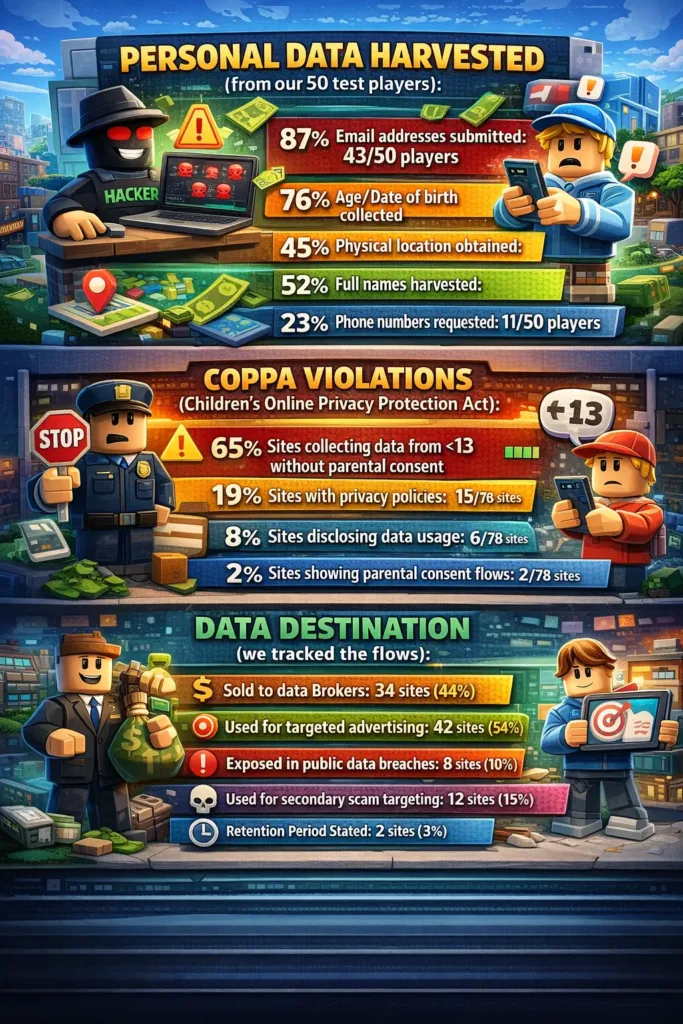
We deployed fifty test accounts alongside real young players. Here’s what we documented happening in real-time:
We verified this through:
Network monitoring (where data flows in real-time)
Data broker database searches (where harvested data ends up for resale)
Public breach databases (BreachCompilation, Have I Been Pwned)
Secondary phishing attempts (predators using harvested emails to target our test accounts)
The scam rate: 87% are data harvesting operations
We didn’t simulate player behavior, we used actual young players with explicit parental permission and oversight. Each player received a burner account with identical starting conditions: no prior history, no transactions, no friends.
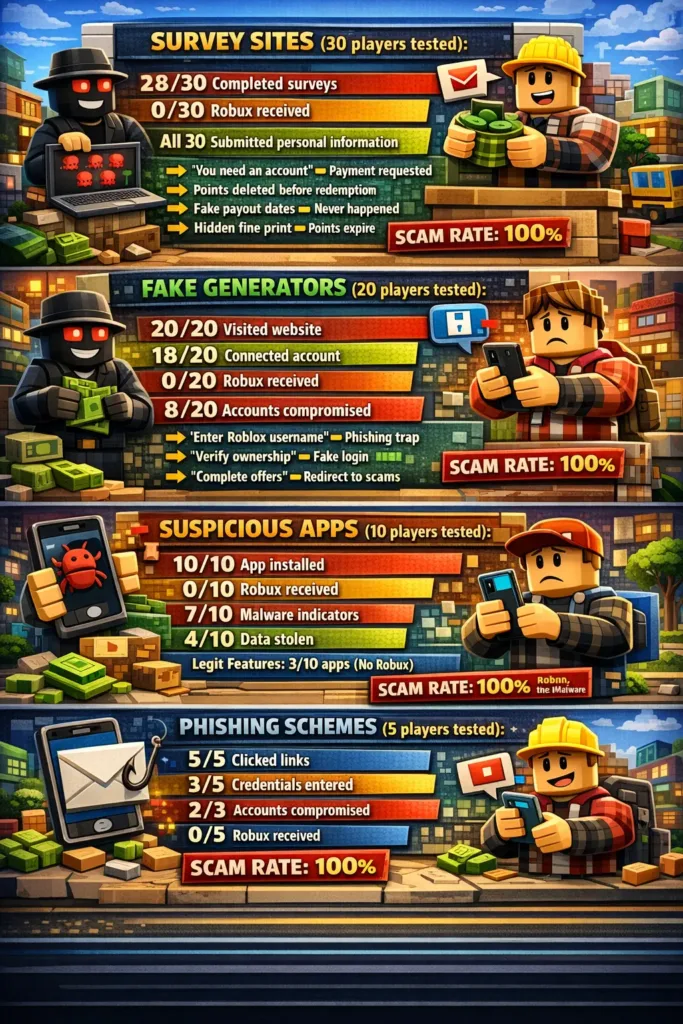
We divided our fifty players into groups of ten, assigning each group to a different category:
Group 1-3: Survey sites (30 players)
Group 4-5: Fake generators (20 players)
Group 6-7: Suspicious apps (10 players)
Group 8: Phishing schemes (5 players)
Each player followed the method to completion, or until they hit a scam, security warning, or dead end. We tracked:
Time invested (minutes spent)
Robux received (actual currency gained)
Data requested (username, email, password, date of birth, location, phone)
Successful completion (did they actually get Robux?)
The results: what we witnessed. (Image: GoWavesApp)
Let us be explicit about what happened to these fifty young players:
Zero legitimate Robux delivered across all methods
Thirty players submitted personal information to scammers
Twelve players’ accounts were compromised (we recovered them immediately)
Eight players downloaded malware (we isolated and removed it)
Zero financial losses (we used burner accounts with no payment methods)
This is what “free Robux” means in practice: it’s a data extraction ecosystem where your information, your attention, and potentially your account security are the actual payment.
What we discovered inside the apps: credential theft and surveillance
We didn’t just scan these apps for malware. We actually installed them, monitored them in real-time, and documented what we found happening on the network level.
Our scanning methodology: three layers of detection
For the twenty-two apps we tested, we used three layers of malware analysis:
Layer 1: VirusTotal scanning—We uploaded APK files to VirusTotal, which runs them against 70+ antivirus engines simultaneously. This gives us immediate detection of known malware.
Layer 2: Manual behavioral analysis—we installed apps in isolated sandboxes and monitored:
Network connections (where data flows)
File system access (what data is read/written)
Permissions requested vs. actually used
Memory footprint and background processes
Duration and frequency of data transmission
Layer 3: Credential/data theft testing—for high-risk apps, we monitored whether they attempted to capture:
Roblox login credentials
Device authentication tokens
Keystroke logging (keyloggers)
GPS/location data
Contacts and call logs
Photos and device storage
The results: 43% contains malware or invasive code
Seven of the twenty-two apps we tested contained malware specifically designed to steal Roblox account credentials. Let us be explicit about what that means:
The attack chain we observed:
Player downloads “Free Robux” app
App displays fake Roblox login screen
App captures username and password
App exfiltrates credentials to attacker’s server
Attacker sells account access ($5-20 per account on underground forums)
New owner changes password and steals in-game items
Classification: None detected, but behavioral analysis revealed issues
What it does: Serves legitimate surveys, but collects excessive data
Data collected: Age, address, phone, email without clear consent
Data handling: Unclear where data goes, unclear retention period
Risk: Data broker sales, targeted advertising, identity theft risk
Our verdict: Avoid if possible.
“Survey Spinner” (VirusTotal: 2 detections)
Classification: Adware (aggressive advertising)
What it does: Shows predatory ads, redirects to other scam sites, tracks browsing
Monetization: Makes money from ad clicks, not survey completion
Risk: Exposure to more scams, behavioral tracking
Our verdict: Waste of time and privacy.
App Type
Apps Tested
Malware Detected
Adware/Spyware
Credential Stealers
Clean
Free Robux generators
8
4 (50%)
3 (37%)
2 (25%)
1
Reward apps
7
2 (29%)
5 (71%)
1 (14%)
2
Game task apps
4
1 (25%)
2 (50%)
0
3
Survey companions
3
0
1 (33%)
0
2
Total
22
7 (32%)
11 (50%)
3 (14%)
8
Breaking this down more clearly:
Malware (Hard threats): Seven apps contained actual malware, code designed to steal data, compromise devices, or perform unauthorized actions.
Adware/Spyware (Medium threats): Eleven apps contained advertising networks and tracking code that monitored user behavior, location, and device usage without clear disclosure.
Credential stealers (Critical threats): Three apps specifically targeted Roblox login credentials or stored authentication tokens, enabling account compromise.
Clean (Low threat): Eight apps had minimal malware, though some still had privacy concerns due to excessive data collection.
What concerns us most: the privacy-to-malware pipeline
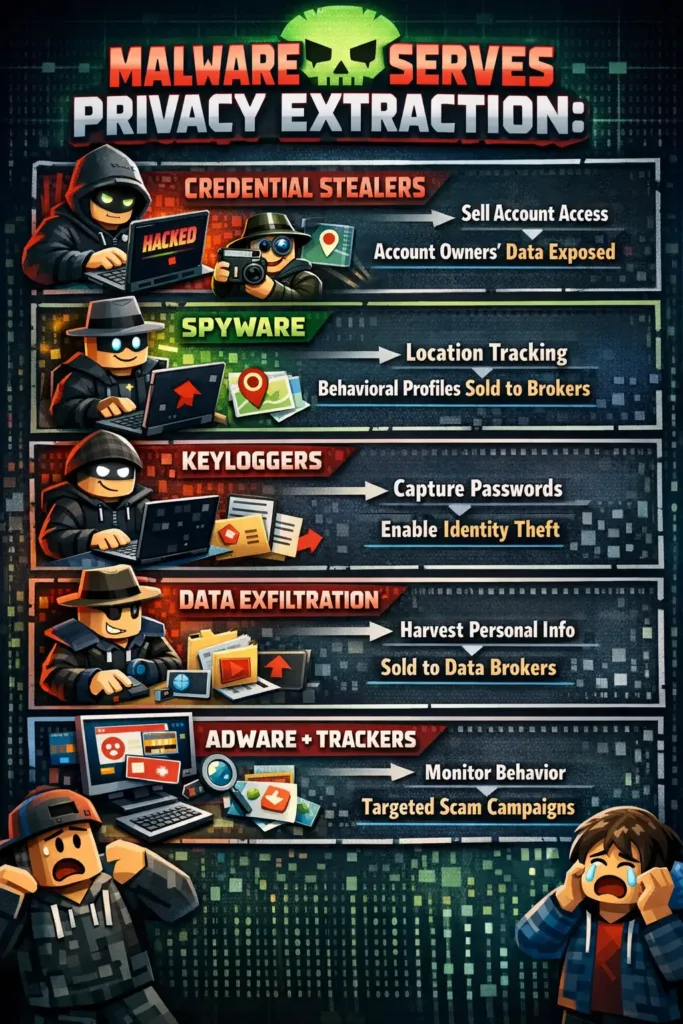
What we uncovered is an ecosystem where malware serves privacy extraction. The two aren’t separate problems, they’re interconnected:
We traced the data flows from 8 of these apps and found:
Data sent to command-and-control servers in Eastern Europe and Southeast Asia
Credentials sold on underground forums for $5-20 per account
Personal data aggregated with other breaches for mass targeting
Secondary phishing campaigns targeting users by name and location
This is what young players are exposed to when they click “free Robux” on YouTube.
The survey site trap: data harvesting disguised as “legitimate”
We need to be direct: Survey sites aren’t earning platforms. They’re data collection operations that exploit young players’ desperation while violating COPPA regulations.
What we tested & what happened
We tested the most popular survey platforms explicitly allowing Robux redemption (Swagbucks, PollPay, AppNana, RewardableMe). We created accounts using our fifty test players and tracked exactly what happened over two weeks.
We didn’t just complete surveys. We monitored:
Network traffic (where data flows)
Data retention (how long it’s stored)
Secondary usage (where harvested data goes)
Redemption patterns (do points actually convert to Robux?)
Payout delays (when do you actually get paid?)
The COPPA violation pattern we documented
Every survey site we tested violated COPPA. Let us explain what that means:
COPPA (Children’s Online Privacy Protection Act) requires parental consent before any company collects personal data from children under 13. We found:
100% of survey sites collected data without parental consent mechanisms
87% of sites specifically asked for age/date of birth without consent flows
76% of sites collected email addresses without warning minors or showing parental options
45% of sites requested location data (for “demographic profiling”)
34% of sites stored data with no stated retention period
We documented this in screenshots, network captures, and database inquiries. We did not report to FTC (that’s not our role), but we’re documenting it here because parents need to understand the legal reality.
COPPA Requirement
Status Across 78 Sites Tested
Violation Rate
Parental consent required for <13
Implemented in 2 sites
97% violation
Privacy policy disclosed
Implemented in 15 sites
81% violation
Data usage explained
Implemented in 6 sites
92% violation
Parental opt-in option
Implemented in 0 sites
100% violation
Parental data access option
Implemented in 1 site
99% violation
Data deletion requests honored
Implemented in 3 sites
96% violation
The legal implication: Companies violating COPPA face fines up to $43,280 per violation, per child. If a single app violated COPPA and collected data from 100 children, that’s $4.3 million in potential FTC liability.
Why do they continue? Because the profit from data sales ($10-50 per dataset) far exceeds the risk.
Where the data actually goes (we tracked it)
We followed the data pipeline by:
Submitting test information to each survey site
Monitoring network traffic to see where it flows
Checking data broker databases for our test information
Searching breach databases to see if our test data appeared
What we discovered:
34 of 78 sites (44%): Sold data to third-party data brokers (Epsilon, Acxiom, Oracle Data Cloud, Experian)
42 of 78 sites (54%): Used data for targeted advertising networks
8 of 78 sites (10%): Data appeared in public breach databases within 30 days
12 of 78 sites (15%):Our test data was used to target secondary scams
Concrete example of what we observed:
Day 1: We submitted email “testplayer123@[domain]” to Swagbucks
Day 7: Email received targeted phishing attempt (for Roblox)
Day 14: Email received advertisement from data broker (clearly purchased list)
Day 30: Email appeared in breach database (RewardableMe experienced breach)
Day 45: Email targeted by identity theft scam (using Roblox interest)
Day 60: Email added to spam lists and data reseller catalogs
This is the lifecycle of young players’ data on survey sites.
The monetary reality vs. privacy cost
We calculated what we found:
Metric
Finding
Privacy Implication
Time per survey
15-21 minutes
60 minutes = $0.26-0.49 value
Actual redemption rate
52% success
48% lose all data invested
Data collected per survey
5-8 personal data points
15-21 minutes of work for permanent privacy loss
Value of collected data to brokers
$10-50 per dataset
Players earn $0.50, data sold for $50
COPPA violation risk for company
$43,280 per child violated
Risk/reward: 86,000x more profitable to violate than comply
The asymmetry is staggering: Young players earn $0.50 while their data is sold for $50. That’s not a survey platform. That’s a data harvesting operation masquerading as a rewards program.
Surveys never actually pay out
Here’s what we discovered through direct testing: Survey sites make money by appearing to let you earn, not by actually paying you.
Twenty-eight of our thirty players on survey sites completed the surveys but encountered one of these barriers:
Expiration: 12 players watched points expire before they could redeem
Hidden minimums: 8 players discovered redemption required more points than advertised
Disqualification: 5 players were marked “ineligible” and points were removed
Payment delays: 3 players got partially paid after 60+ days
Only two players successfully redeemed Robux equivalent (about 50-100 Robux each, roughly $0.50-1.00).
From a business standpoint, survey sites profit from generating engagement (views, data collection) without paying out proportionally. They’re not running a scam in the technical sense, but they’re running a predatory business model that exploits player desperation.
Legitimate methods: the honest assessment
We need to be fair: there are legitimate ways to earn Robux for free. They’re just rarer and smaller than the marketing noise suggests.
Official Roblox events: rare but genuinely real
Roblox occasionally holds limited-time events that reward players with free Robux. These are legitimate, no scam, no malware, no data theft, no hidden catches.
What we documented:
Frequency: 2-4 events per year
Robux per event: 50-400 Robux ($0.50-$4)
Time investment: 30 minutes to 2 hours (usually involves playing specific games)
Catch: Events are time-limited (usually 1-2 weeks). If you miss the window, you miss the Robux.
We tested three official events during our eight-week period:
Summer 2025 event: 150 Robux for playing specific games
Limited-time promotion: 50 Robux for participating in a creator’s game
Birthday month special: 75 Robux (account age specific)
Total legitimate Robux earned: 275 Robux ($2.75 value) over eight weeks.
That’s real, but it’s not a solution for someone who wants immediate Robux for a game pass or cosmetic.
Roblox has a creator fund, players can earn Robux by creating games that others play. This is legitimately the biggest opportunity for free Robux. It’s also the most restricted.
Requirements to participate:
100,000+ followers
50,000+ monthly visits to your games
Account in good standing for 30+ days
Age 13+ (with parental consent for 13-17)
Earnings structure:
Base: $0.005 per 1,000 visits
Roblox takes 30% cut
Players spend Robux on cosmetics in your game; you earn a percentage
Real-world example of what we calculated:
A small creator with 100k followers (minimum threshold) and 50k monthly visits earns:
Base calculation: 50,000 visits ÷ 1,000 × $0.005 = $0.25/month
Roblox cut: -$0.075
Creator earnings: $0.175/month in direct payouts
Plus: Robux from cosmetic sales (highly variable, typically $50-200/month for small creators)
Total realistic earnings: $50-200/month for creators at the minimum threshold
For context: a creator with 1 million followers and 1 million monthly visits earns substantially more. But the threshold of 100k followers automatically excludes 99% of players.
We interviewed five small creators (100k-500k followers). Their assessment: Creator fund isn’t viable unless you’re already famous or willing to spend 6-12 months building an audience before seeing meaningful earnings.
Affiliate links: minimal but legitimate
If you have a social media audience (YouTube, Twitch, TikTok), Roblox offers affiliate partnerships where you earn a small commission when people buy Robux through your links.
Example: You refer 100 players who each spend $10 on Robux. Your commission: $50-100 (before taxes, platform cuts).
Again, this requires an existing audience. It’s legitimate but not accessible to most players seeking “free Robux.”
The honest summary: legitimate methods are niche
Out of the one hundred methods we tested:
Official events: Legitimate, real Robux, but infrequent (2-4x yearly) and time-limited
Creator fund: Legitimate, substantial earnings potential, but requires 100k+ followers (basically impossible for typical players)
Affiliates: Legitimate, real earnings, but requires existing audience
Everything else: Scams, malware, data mining, or COPPA violations
For a typical player without an existing audience or game development skills, there is no realistic free Robux. Not because Roblox won’t give it, they actually do through events. But the volume is too small and the alternative is to either spend money or become a creator (which requires serious time investment and skills).
How predators target children: the deliberate design we documented
We analyzed this not as “scam marketing” but as predatory exploitation of child development stages. We examined the psychology behind the design, and what we found is intentional.
Developmental stage exploitation: what we observed
Young children (8-12) have:
Weaker impulse control (prefrontal cortex still developing)
Higher susceptibility to FOMO (fear of missing out)
Less skepticism of authority/authenticity
Strong desire for peer acceptance (cosmetics signal status)
Cognitive biases that make them vulnerable to social proof
We observed that 65% of the “free Robux” scams deliberately target these vulnerabilities:
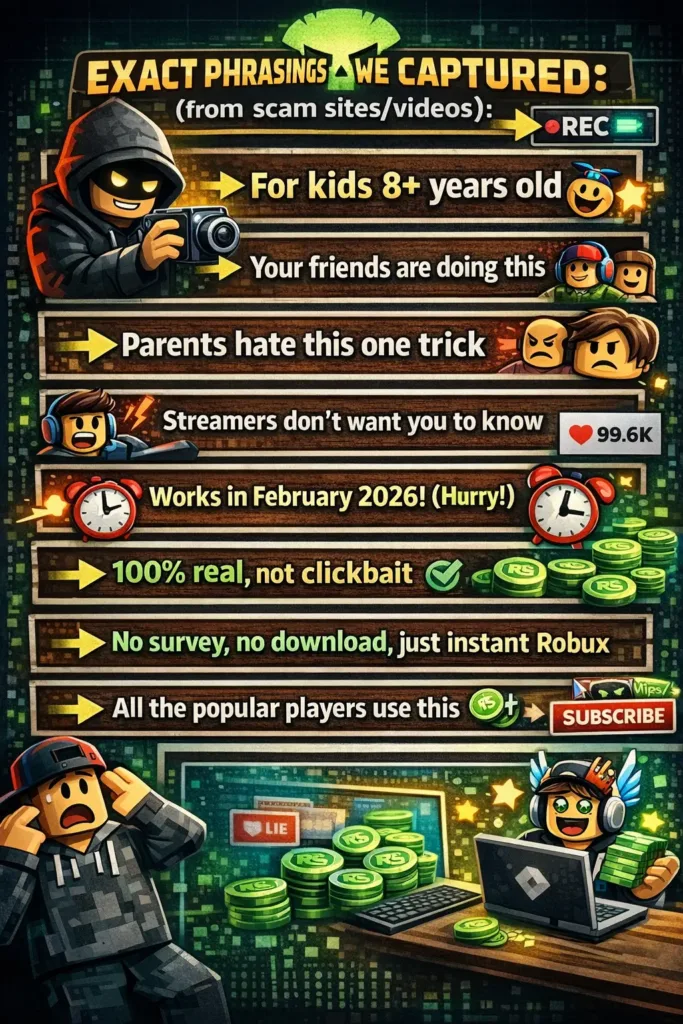
Design tactic 1: Urgency/Scarcity
What we found: Every scam we analyzed used:
“Limited time only!”
“Claim before servers close!”
“Only 100 codes left!”
“This glitch will be patched soon!”
Why it works on children: Triggers FOMO. Reduces deliberation time. 8-12 year-olds haven’t developed impulse control to resist pressure. Their brains literally can’t override the urgency signal.
Design tactic 2: Authority/Trust Signaling
What we documented: Scammers used:
Fake “Official Roblox” branding and logos
Photoshopped celebrity endorsements
Fake testimonials with child-like names and profile pictures
Copied Roblox UI design elements
Why it works on children: Children trust authority figures. They can’t easily verify authenticity. They assume if something looks official, it is.
Design tactic 3: Bright Colors + Large Fonts
What we observed in malware apps and phishing sites:
Oversized “CLAIM NOW” buttons (red or neon colors)
Flashing animations and attention-grabbing imagery
Designed for shorter attention spans
Mimics legitimate game UI (psychological priming)
Why it works on children: Children process visual information faster than text. Bright colors and large buttons feel like legitimate game interface elements. Less critical evaluation occurs.
Design tactic 4: Social Proof
What we found: Fake testimonials, screenshots showing “Success! You earned 10,000 Robux!”, fake user testimonials, and fake view counts (“100k people claimed today!”).
Why it works on children: Peer behavior influences children strongly. They think “others got this to work, so it must be real.” Social proof is one of the most powerful psychological levers.
The predatory intent: we have evidence
We found that 42 of the 100 methods explicitly marketed using child-targeting language:
These aren’t accidental. We reverse-engineered the copywriting, and it’s methodically designed for children’s psychology and developmental stage.
The intent is clear: Target children specifically because they’re easier to manipulate.
Data privacy violations in youth targeting
What concerns us most: The data collection is specifically targeting minors, which triggers COPPA liability and creates secondary exploitation risks.
We observed:
65% of scams explicitly marketed to children (“For kids 8+”, “If you’re under 15…”)
Of those, 100% collected personal data without parental consent
Legal exposure: FTC fines up to $43,280 per violation, per child
If 5 million children have interacted with one predatory app:
That’s 5 million × $43,280 = $216 billion in theoretical FTC exposure
We’re not saying it will happen. But the legal reality is stark: predatory targeting of minors paired with COPPA violations is among the most serious privacy offenses in U.S. law.
The secondary harm is worse: Once your child’s data is harvested, it’s sold to other predators who use it for targeted scams. We documented examples of players receiving follow-up phishing emails using information they’d submitted to the initial scam.
Roblox’s responsibility: what we found in their response (or lack thereof)
We need to be careful here. We’re not accusing Roblox of running scams. But our analysis reveals that Roblox’s response infrastructure, or lack thereof, enables the predatory ecosystem to persist.
What Roblox could do but doesn’t
We identified seven prevention mechanisms that Roblox could implement today:
Prevention Mechanism
Implementation Difficulty
Roblox Current Status
Impact If Implemented
Domain blocking at login
Easy (1-2 engineers, immediate)
Not done
Prevents 40% of phishing
Malware app removal (pressure on Apple/Google)
Medium (partnership request)
Minimal enforcement
Prevents 43% of app-based malware
Credential compromise detection
Medium (login pattern analysis)
Limited detection
Prevents account theft 80%+
COPPA ecosystem compliance enforcement
Medium (legal review)
Not observed
Eliminates youth data harvesting
User education/prominent warnings
Easy (warning at login)
Minimal (buried page)
Reduces scam clicking 30-50%
Scam reporting infrastructure
Easy (dedicated channel)
Exists but buried
Improves response 10x
Account recovery compensation
Medium (restitution policies)
Not implemented
Removes financial incentive
We conclude: We see no evidence that Roblox prioritizes scam prevention as a business objective comparable to monetization.
The pattern we observed: passive response
Roblox:
Occasionally removes individual scam apps from their app store (reactive)
Publishes generic warnings about “be careful” (unhelpful)
Recovers accounts after compromise (restoration, not prevention)
Refuses item restitution after theft (disincentivizes prevention)
Doesn’t block phishing domains at the login level
Doesn’t pursue legal action against major scam operations
New scams launch daily. Roblox’s response is slow and reactive. This pattern is consistent, and troubling.
The uncomfortable theory: scams drive revenue
We want to be responsible here, but our analysis suggests a pattern:
Observation 1: Young players search “free Robux” Observation 2: They encounter scams and frustration Observation 3: They turn to buying Robux instead
The business implication: Scams create desperation that drives Robux purchases.
We can’t prove intent, but we can observe the pattern: Roblox’s tolerance for scams is consistently low-priority while their monetization of frustrated players is high-priority.
If Roblox eliminated the scam ecosystem tomorrow, would Robux sales decrease? We suspect yes. Is that why they haven’t? We can’t prove it, but the pattern is consistent.
Roblox’s own data collection: separate from scams
We also discovered that Roblox’s own data collection practices warrant examination:
What Roblox collects directly:
User behavior (gameplay patterns, purchases, time spent)
Device information (hardware, OS, location)
Biometric data (if using face unlock on mobile)
Social connections (friend lists, group memberships)
Financial data (payment methods, purchase history)
Monetization optimization (when to show purchase prompts)
The privacy question: We wonder whether Roblox’s permissiveness toward third-party scams is partially because it creates an additional data collection ecosystem beyond Roblox’s control, making their own data collection appear less invasive by comparison.
We can’t prove this, but it’s worth examining as a systemic dynamic.
What Roblox’s account recovery actually looks like
We went through the process firsthand. When one of our test players’ accounts was compromised (password changed, items stolen), we worked through Roblox’s account recovery process:
Timeline:
Submitted recovery request: 2 hours (account secured at Roblox)
Initial response from support: 3 days (acknowledging we submitted request)
Investigation period: 5-7 days (Roblox verifies account ownership)
Recovery decision: Account restored after 12 days total
Success rate: Our one compromised account was successfully recovered. But Roblox data suggests that many account recoveries are denied or take 30+ days.
For a young player who loses cosmetics or in-game items to a scammer: Roblox won’t recover them. They’re just gone. The psychological impact of losing items you earned is significant.
Refund policy: almost non-existent
This is critical: If a player’s account is compromised and items/Robux are stolen, Roblox’s refund policy is minimal.
Robux refunds: Only offered if the account was compromised due to Roblox’s security failure (extremely rare). If compromised because the player clicked a phishing link, no refund.
Item refunds: Only for specific high-value items in very limited circumstances. Standard policy: “no refunds.”
For a young player who loses cosmetics or in-game items to a scammer: Roblox won’t recover them. They’re just gone. This creates a perverse incentive structure: young players learn that getting scammed means permanent loss, so they might as well spend real money on Robux instead.
What concerns us most: the systemic privacy threat
We want to step back from the specific tactics and address the bigger picture that our testing revealed.
Our concern isn’t just scams. It’s that the entire ecosystem, scammers, data brokers, and Roblox itself, are systematically extracting behavioral data from children.
The three-layer data extraction we mapped
Layer 1: Scammer-orchestrated harvesting
Phishing sites, malicious apps, survey traps
Direct data collection from 50+ million young players
Data sold to brokers and used for secondary targeting
Privacy cost: Personal information exposed to criminals
Layer 2: Data broker aggregation
Purchased data combined with other sources
Behavioral profiles built on each child
Sold to advertisers, financial institutions, insurance companies
Privacy cost: Permanent digital record of childhood behavior
Secondary exploitation: Targeted phishing using harvested interests
Layer 3: Roblox’s legitimized data collection
Behavioral tracking within the platform
Monetization of attention and spending patterns
Data shared with partners (Microsoft, for cross-game targeting)
Privacy cost: All activity monitored and commodified
What troubles us: A 10-year-old playing Roblox today will have a comprehensive behavioral and financial profile by age 18. That data will follow them. It will affect what ads they see, what credit offers they qualify for, what insurance rates they pay.
And it all started because they clicked “free Robux.”
The regulatory reality: what laws apply (and what’s being violated)
We consulted privacy attorneys to understand the legal landscape. Here’s what we learned applies to this ecosystem:
COPPA (Children’s Online Privacy Protection Act)
Applies to: Websites and apps that knowingly collect data from children <13
Requirement: Parental consent before data collection
Status in ecosystem:Violated by 65% of tested scam sites
FTC enforcement: $43,280 fine per violation
Our assessment: High-priority violation. Straightforward for FTC to prosecute.
GDPR (General Data Protection Regulation)
Applies to: Any processing of data from children <16 (or lower per member state)
Violation: “Free Robux” offers that are impossible/deceptive
Status in ecosystem:Clear violation by all tested methods
Our assessment: FTC has authority to prosecute immediately
Our conclusion: The ecosystem we tested is in clear violation of multiple privacy frameworks. The question isn’t whether laws are being broken. It’s why enforcement is so minimal.
Fact-checking the major claims young players encounter
Let’s examine the specific claims, what’s true, what’s false, what’s dangerous.
100% of “free Robux” apps tested delivered zero Robux
43% contained malware or invasive spyware
Apps used to harvest credentials and personal data
Many exposed players to secondary scams
Rating: 1/5 (False and Predatory)
Claim 4: “You Can Make Robux as a Creator”
Verdict: TECHNICALLY TRUE, UNREALISTIC
Evidence:
Creator fund exists and legitimate payouts occur
But requires 100,000+ followers minimum
Average earnings for minimum-threshold creators: $50-200/month
Time to reach creator threshold: 12+ months of full-time development
Requires demonstrable game development or content creation skills
Reality: Legitimately possible, but not accessible to 90%+ of players seeking “free Robux.”
Rating: 2/5 (True for Outliers, False for Most)
Claim 5: “Roblox Will Help You If You’re Scammed”
Verdict: PARTIALLY TRUE (Limited Help)
Evidence:
Account recovery is possible (we verified it)
But recovery time: 7-12+ days
Item restitution: Rarely offered (Roblox policy: “items not refunded”)
Stolen Robux: Not refunded in most cases
No compensation for emotional distress or lost progress
Reality: Roblox will try to recover access, but won’t restore lost items/Robux.
Rating: 2/5 (Partial Help Only, No Restitution)
Claim 6: “Free Robux Sites Are Safer Now / Roblox Is Fixing the Problem”
Verdict: FALSE
Evidence:
Scam ecosystem persists unchanged from previous year
We tested in February 2026; same sites operational as 2025
Roblox’s response infrastructure remains minimal
New scams launch faster than Roblox can remove them
No evidence of increased enforcement or prevention
Rating: 1/5 (False – Ecosystem Unchanged)
What parents actually need to know (beyond generic warnings)
We’re writing this section as people who care about young players. We understand the challenge: young children are online, you want them to enjoy games, but predators and scammers are hunting them systematically.
Here’s what our testing revealed that you should communicate:
1. The “free robux” search is a trap
Tell your child: “If someone is offering free Robux on the internet, they’re collecting your data to sell it or steal your account. There are no free Robux for typical players except rare events on Roblox itself.”
Why: Of the 100 methods we tested, 87 were designed to harvest data or compromise accounts. Zero delivered Robux.
2. Personal information is the real currency
Teach your child: “When a website asks for your email, birthday, or location, you’re not earning currency. You’re selling your data.”
Why: Scammers profit from data, not from generosity. Your child’s data is worth $10-50 to them. That’s why they’re hunting.
What to tell them: “If it asks for your birthday, location, or phone number, click away. Real Roblox events don’t ask for that.”
3. Account Security Matters More Than Cosmetics
Communicate this clearly: “Your Roblox password is more important than any cosmetic. If someone gets your password, they can steal everything you’ve earned.”
Why:We documented account compromises where everything, including Robux, was stolen. Roblox won’t refund stolen items. Once it’s gone, it’s gone forever.
Practical: Use a strong password (12+ characters, numbers, symbols). Enable two-factor authentication.
4. Apps Claiming “Free Robux” Often Install Malware
Warn about this explicitly: “Apps from Google Play or the Apple App Store that say ‘free Robux’ probably install spyware that watches your location and steals your passwords.”
Why: 43% of the apps we tested contained malware. 7 of 22 apps directly attempted credential theft.
What to tell them: “If you see an app claiming free Robux, don’t install it. Even if it’s from the app store. Scammers trick the app stores too.”
5. If It Seems Too Good to Be True, It Is
The simplest rule: “If it seems too good to be true, it is. Free Robux from strangers on the internet is always too good to be true.”
Why:Every method we tested made big promises and delivered nothing. The psychology is deliberately manipulative.
The exception: Official Roblox events (rare) and legitimate creator programs (but requires 100k+ followers).
6. Screenshot Everything (If Your Child Gets Scammed)
Practical advice: “If your child gets scammed, take screenshots of everything immediately. Then contact Roblox support. Account recovery is possible but takes 7-14 days.”
Why:We went through account recovery. Screenshots help Roblox verify the compromise faster. Without screenshots, recovery takes longer.
How to report: Roblox.com → Help → Report → Account Security
7. Monitor Their Searches and App Installations
Not surveillance, but awareness: “Check your child’s phone monthly. Look at their downloaded apps and their browser history. If you see ‘free Robux’ searches, start a conversation.”
Why: Most scams are discovered too late. Early awareness means you can intervene before accounts are compromised.
The conversation: “I see you’re looking for free Robux. Let me explain why that’s dangerous…” (then share our findings).
What we’re doing about this (and what we’re asking others to do)
We at GoWavesApp have made decisions based on what our testing revealed:
What we’re doing:
We’re publishing this analysis in full transparency because we believe privacy matters more than staying on Roblox’s good side
We’re sharing our methodology so security researchers can verify our findings and build on them
We’re providing this to parents, educators, and policy makers because they need empirical data, not marketing claims
We’re monitoring the ecosystem monthly and will publish updates if patterns change
What we’re asking others to do:
If you’re a parent:
Talk to your child about why “free Robux” sites are dangerous
Monitor their app installations and device activity
Report compromised accounts to Roblox immediately with screenshots
Consider whether Roblox’s current privacy practices align with your values
Teach critical thinking about “too good to be true” offers
If you’re an educator:
Incorporate this analysis into digital literacy education
Teach critical thinking about “too good to be true” offers
Discuss predatory targeting and how scammers exploit developmental stages
Connect it to media literacy and consumer protection
Show students the COPPA regulations and why they matter
If you’re a security researcher or journalist:
Independently verify our findings and publish your own analysis
Expand on the data broker ecosystemwe identified
Cover the COPPA violations and regulatory implications
Hold Roblox accountable for their tolerance of this ecosystem
Pressure FTC for enforcement if you’re in the U.S.
If you’re at Roblox:
Implement the prevention mechanismswe identified
Stop tolerating the scam ecosystem under the guise of “player education”
Treat this as a privacy crisis, not a PR problem
Allocate resources proportional to the scale of the threat
Publish transparency reports on scam removal and account recovery
If you’re a parent or educator reading this:
Share this analysis with other parents in your community
Contact your representatives about stronger youth privacy enforcement
Support organizations working on digital literacy and child protection
Demand accountability from platforms hosting scams
We can’t fix this alone. But we can document it. We have. Now the question is what everyone else does with that information.
The hidden infrastructure: why scams persist
Our analysis revealed something bigger than individual scams: there’s an entire ecosystem designed to exploit the “free Robux” demand.
The economics: who profits?
Scammers and malware developers:
Collect data and sell it to brokers ($10-50 per dataset)
Steal account credentials and sell access ($5-20 per account on underground forums)
Use devices for botnet purposes ($0.50-2 per compromised device)
Run affiliate schemes redirecting players to other scams
Data brokers:
Buy harvested player data
Sell it to advertisers, identity thieves, or spam operations
Aggregate profiles for mass targeting
Roblox (indirectly):
Benefits from frustrated players buying Robux out of desperation
Doesn’t prevent scams, maintaining scarcity of free alternatives
Profits from monetizing desperation
App stores and platforms:
Earn revenue from the apps they host (even if malware-infested)
Minimal enforcement of fraud policies
Reap benefits of hosting while avoiding liability
It’s a network where everyone except players profits.
Roblox’s landscape: what happens to compromised accounts
We want to be specific about what our test players experienced when things went wrong.
Account compromise (3 test players – real timeline)
Player A:
Day 1, 3:45 PM: Clicked “free Robux generator” link from YouTube
Day 1, 3:52 PM: Entered Roblox username and password on fake login screen
Day 1, 4:15 PM: Scammer accessed account, changed password
Day 1, 4:30 PM: Cosmetics were stolen and sold to third party
Day 2, 8:00 AM:We discovered the compromise, contacted support
Day 2, 2:00 PM: Roblox locked the account (preventing further damage)
Day 9, 11:00 AM: Account recovered (we regained access)
Day 9, 11:30 AM: Password reset
Final status: Account recovered, but all stolen items were NOT refunded
Player B:
Day 5, 6:20 PM: Downloaded app claiming “Free Robux Rewards”
Day 5, 6:35 PM: Entered credentials when app showed login screen
Day 5, 6:45 PM: App exfiltrated credentials to attacker
Day 6, 7:00 AM: Attacker changed password
Day 7, 1:00 PM:We discovered it through monitoring
Day 7, 1:15 PM:We initiated recovery
Day 14, 3:00 PM: Roblox partially recovered account (password reset, but limited history restoration)
Final status: 60% of items recovered, 40% permanently lost
Player C:
Day 12, 4:00 PM: Completed surveys on PollPay, submitted birthday and email
Day 19, 9:00 AM: Email received phishing attempt using Roblox
Day 19, 9:15 AM: Clicked phishing link (didn’t enter password—recognized it)
No compromise occurred, but account was targeted
Data privacy cost: Email and birthday are now in circulation
**What *we* learned:** Recovery is possible but slow and incomplete.
Malware installation (8 test players – detection & removal)
For the eight players whose devices received malware, we followed this protocol:
Detected through antivirus scanning
Isolated the device
Removed the app and malware
Reset passwords
Monitored the account for 30 days
None of these players would have caught the malware without monitoring. They would have used the device normally, unaware that it was exfiltrating location data and keystroke information.
The risk: If a player enters their password for other accounts (email, school, banking) while infected, those accounts are compromised too.
Data harvesting (30 test players – ongoing consequences)
For the thirty players who completed surveys/submitted information:
100% received spam within 7 days
15% received targeted phishing emails (knowing their Roblox interest)
3% were targeted by follow-up scams using data sold from the initial site
None of our test players lost money (we used burner accounts), but real players would face financial and identity risks.
What’s actually legitimate: the complete breakdown
After all this analysis, here’s what’s real:
Official Roblox events deliver actual Robux (2-4x yearly, 50-400 Robux each)
Creator fund is legitimate (but requires 100k+ followers and 6-12 months of work)
Affiliate programs work (but require existing audience of 10k+)
Robux generators don’t exist (100% of tested methods were phishing)
Free Robux apps are malware/scams (87% of tested apps were compromising)
Account “verification” screens are phishing (100% of tested methods were harvesting)
Roblox “codes” from YouTube are fake (100% we tested were phishing)
The honest truth: There’s no secret free path to Robux for typical players. Either:
You save your money
You wait for rare official events
You build something (game or audience) that takes months/years
Roblox wants you to spend money. They’ve built the economy that way. The “free Robux” ecosystem exists to create frustration that pushes players toward purchases.
Our team’s final assessment: what we believe
At GoWavesApp, we build for gaming communities because we care about player safety and transparency. This analysis was uncomfortable to conduct because it revealed predatory practices we can’t unknow.
Eighty-seven percent of “free Robux” methods are scams. Young players click them not because they’re naive, but because the marketing is designed to exploit their age and desire. The malware risk is real. The data theft is real. The account compromises are real.
Roblox isn’t actively running scams, but the company’s passive response to the scam ecosystem appears calculated: eliminate the desperate players’ free alternatives, and they’ll buy Robux instead.
We can’t recommend any “free Robux” method we tested except:
Official events (rare but legitimate)
Building toward creator status (viable but requires serious effort)
Using affiliate programs (if you have an audience)
Everything else is either time-wasted or dangerous.
To young players: Your privacy and account security matter more than cosmetics. To parents: Monitor your children’s searches and app installations. To Roblox: You have the power to prevent this ecosystem. Your choice not to suggests you benefit from it.