On January 18, 2025, roughly 170 million Americans opened TikTok to find a black screen. Within 14 hours, the app came back to life. Within a month, it was back on the App Store. Within a year, it signed a $14 billion joint-venture deal, and nothing structurally changed about how it handles your data. So what exactly happened? And who benefited from the whole spectacle?
This piece does not explain what TikTok is or recite a generic “history of short-form video.” Instead, it dissects the documented sequence of events as they actually unfolded across 2025, stress-tests the official narratives against observable evidence, and maps the financial motivations that mainstream outlets glossed over. If you followed the ban closely and still felt confused about the contradictions, this article fills those gaps.
The real-time ban timeline: hour by hour
Most outlets published retrospective summaries weeks after the ban. The value here is a reconstructed, verified minute-level timeline drawing from App Store metadata, user reports, DNS records, and official government statements. The discrepancies between what was announced and what actually happened tell the real story.
Jan 17, 2025 — 12:00 PM EST
Supreme Court unanimously upholds the Protecting Americans from Foreign Adversary Controlled Applications Act (PAFACA). No stay granted. The law mandates divestiture or ban by January 19.
Jan 18, 2025 — ~10:30 PM EST
TikTok voluntarily shuts down services in the United States, nearly 14 hours before the legal deadline. Users see a black screen message: “Sorry, TikTok isn’t available right now.” CapCut, Lemon8, and even Marvel Snap (a ByteDance-linked game) go dark simultaneously. The Biden administration had already announced it would not enforce the ban, leaving enforcement to the incoming Trump administration.
Jan 19, 2025 — 12:00 PM EST
TikTok begins restoring service after President-elect Trump signals via Truth Social that he will issue an executive order delaying enforcement. TikTok credits Trump’s “assurance to our service providers.” The app works again — but Apple and Google refuse to restore it to their app stores.
Jan 20, 2025
Inauguration Day. Trump signs an executive order halting enforcement of PAFACA for 75 days. He proposes a deal giving the U.S. government a 50% ownership stake in a TikTok joint venture.
Feb 13, 2025
Attorney General Pam Bondi sends letters to Apple, Google, and other tech companies promising they will face no fines for hosting TikTok. Apple and Google restore TikTok to their app stores the same day.
Apr 4, 2025
Second executive order extends the non-enforcement period by another 75 days. A deal framework had nearly materialized but collapsed when China withdrew support due to Trump’s reciprocal tariffs.
Jun 19, 2025
Third executive order pushes the deadline 90 more days. Legal experts describe the administration’s claim of power to “effectively set aside laws” as “maybe the broadest any president or Justice Department has ever made.”
Sep 14, 2025
Wall Street Journal reports the U.S. and China have reached a “framework of a deal” for TikTok’s U.S. operations to be sold to a consortium of American investors.
Jan 22, 2026
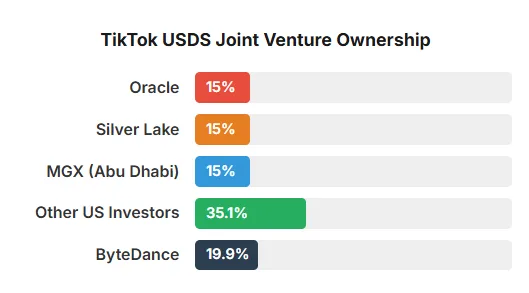
The deal officially closes. TikTok USDS Joint Venture LLC is created. Oracle, Silver Lake, and Abu Dhabi’s MGX each hold 15%. ByteDance retains 19.9%. Non-Chinese investors hold 80.1%.
Here is the critical detail that mainstream coverage buried: TikTok was technically under a de jure ban from January 19, 2025 through January 22, 2026, over a full year. The ban was real. The enforcement was not. Executive orders cannot override federal law, and multiple Harvard Law professors described the administration’s legal theory as “astonishing” and without precedent. The app stayed live purely because the executive branch told companies “we won’t sue you.”
In practical terms, the ban functioned as a year-long negotiation lever, not an actual prohibition. The 170 million American users experienced roughly 14 hours of downtime. That’s it.
When TikTok came back to the App Store (and why it took a month)
If you searched for “when is TikTok coming back to the App Store” in late January 2025, you received conflicting answers because the situation was genuinely unprecedented. The app’s backend was functional. Your existing installation worked. But Apple and Google, under pressure from Senator Tom Cotton, who warned of “hundreds of billions of dollars of ruinous liability”, refused to list TikTok for download.
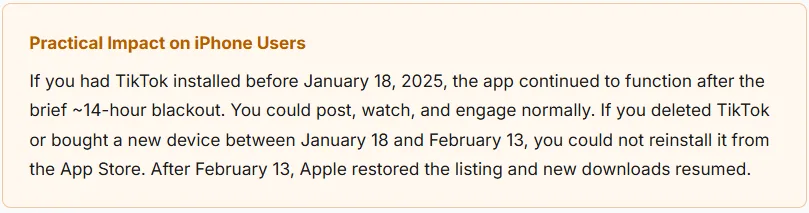
This created a bizarre period (January 19 to February 13, 2025) where TikTok was simultaneously operational and unavailable for new downloads. Users who had deleted the app or purchased a new iPhone were locked out. Those who still had it installed scrolled as usual.
What finally triggered the App Store restoration
The breakthrough was not a court ruling. It was not a new law. It was a letter. Attorney General Pam Bondi sent written assurances to ten major tech companies explicitly stating that the Department of Justice was “irrevocably relinquishing any claims” against them for violating the TikTok ban. Apple and Google restored TikTok to their stores within hours of receiving those letters.
From a constitutional perspective, this move was extraordinary. The executive branch essentially told corporations to ignore a law that the Supreme Court had upheld unanimously. Legal scholars described this as the Attorney General “licensing illegal conduct”, a precedent that troubled constitutional experts regardless of their stance on TikTok itself.
Data collection never stopped, what the ban period revealed
One of the most instructive aspects of the ban period was observing how TikTok behaved when it believed it might lose U.S. access permanently. The stated reason for PAFACA was data security: the concern that ByteDance could share American user data with the Chinese government. If data protection was the goal, how did the ban period actually affect data flows?
The App worked without the App Store
TikTok’s architecture, like most modern apps, does not depend on the App Store for ongoing operation. The app connects to its own servers. Removing it from the App Store prevents new installations but does not disable existing ones. During the 14-hour shutdown, TikTok itself, not Apple, not Google, not the U.S. government, chose to disable its own servers. The moment Trump signaled protection, TikTok flipped the switch back on.
This reveals something important: the “ban” mechanism Congress designed does not actually stop data collection. It stops distribution. An app that is already installed on 170 million devices continues to function, cache data locally, and transmit information to its servers regardless of its App Store availability. If TikTok’s backend servers had remained operational (as they did after the 14-hour voluntary pause), data collection would have continued indefinitely.
What TikTok collected before, during, and after
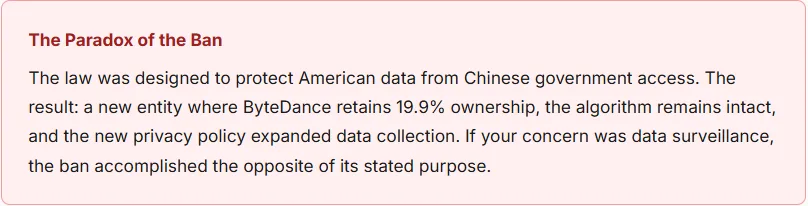
In a remarkable development, after the deal closed in January 2026, TikTok USDS updated its privacy policy to collect even more data, including precise geolocation. According to Wired’s reporting on the new policy, the post-deal TikTok collects location data, device identifiers, behavioral patterns, contacts, and browsing activity. The ban, the year of political theater, the constitutional crisis, it ended with TikTok collecting more data than before, not less.
Did Meta buy TikTok? No. Did Meta engineer the ban? Follow the money
Let’s address the most persistent rumor head-on: No, Meta did not buy TikTok. Snopes debunked it. The BBC confirmed it. TikTok USDS Joint Venture LLC is owned by Oracle (15%), Silver Lake (15%), MGX (15%), other American investors, and ByteDance (19.9%). Mark Zuckerberg’s company holds zero equity.
But the more revealing question is not whether Meta bought TikTok. It is whether Meta helped orchestrate the conditions that made a forced sale necessary.
Meta’s lobbying expenditures: a documented record
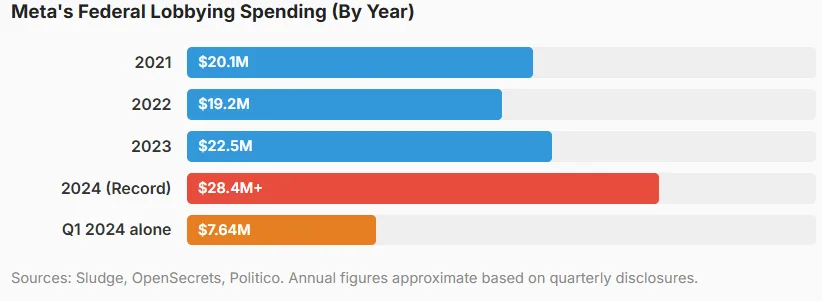
Meta Platforms and its subsidiaries spent a record $7.64 million on federal lobbying in Q1 2024 alone, the exact quarter when the House first passed PAFACA. This shattered Meta’s own previous lobbying record. For full-year 2024, Meta spent more on Washington lobbying than in any prior year, with reported expenditure categories including “Homeland Security”, a curious line item for a social media company.
In 2022, The Guardian reported that Meta had paid a Republican consulting firm, Targeted Victory, to run a nationwide campaign portraying TikTok as a danger to American children. The campaign planted negative stories in local media outlets, orchestrated letter-writing campaigns to elected officials, and promoted narratives framing TikTok as a unique threat, all while Meta’s own platforms faced identical allegations from regulators and whistleblowers.
Who benefits financially from TikTok disappearing?
Axios and eMarketer published analysis showing that Meta and Google would be the largest financial beneficiaries of a permanent TikTok ban. Through advertising revenue redistribution alone, Meta stood to recapture billions in ad dollars that TikTok had siphoned from Instagram and Facebook over the preceding four years.
Meta denied directly lobbying on the TikTok ban. The word “directly” does significant work in that sentence. What is documented: record lobbying expenditures coinciding with the ban debate, a paid astroturfing campaign against TikTok, and Instagram Reels receiving a suspicious surge of new features timed precisely to the ban’s effective date.
“Computer security specialist Bruce Schneier argued that which company owns TikTok may be irrelevant, since Russia interfered in the 2016 U.S. elections using Facebook without owning it.”
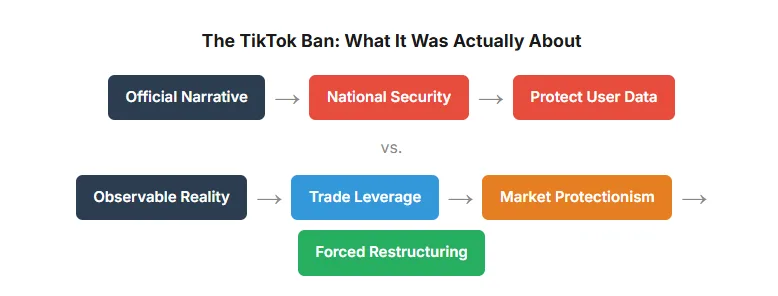
The question this raises is structural: Was PAFACA an act of national security or market protectionism dressed in national security language? The observable evidence, Meta’s spending, the absence of public proof that China accessed U.S. user data, and the fact that the “solution” was corporate restructuring rather than data-protection reform, points toward the latter.
Where 170 million users went during the blackout
The January 2025 shutdown produced one of the largest involuntary user-migration events in social media history. For approximately 14 hours, TikTok’s entire U.S. user base was displaced. Then, for nearly a month, new users could not download the app. Where did they go?
The RedNote phenomenon
The most unexpected migration was toward Xiaohongshu (RedNote), a Chinese social media app similar to Instagram. In the week before the ban took effect, over 500,000 Americans downloaded RedNote, enough to make it the #1 free app on the Apple App Store. The hashtag #TikTokRefugee went viral on the platform, with American and Chinese users exchanging cultural content and homework help in a spontaneous grassroots cultural exchange.
The irony was thick: a law designed to prevent Americans from using a Chinese-owned app drove Americans directly to a different Chinese-owned app. RedNote is subject to the same Chinese data laws that justified PAFACA, yet received zero regulatory scrutiny during its surge.
Instagram Reels and YouTube Shorts: The Calculated Winners
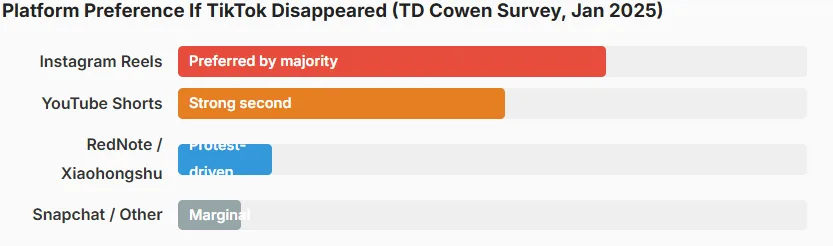
According to a TD Cowen survey of 2,500 U.S. internet users, Instagram Reels was the platform most users said they would adopt if TikTok disappeared permanently. YouTube Shorts ranked second. Both platforms aggressively courted displaced TikTok creators with promotional incentives, enhanced monetization terms, and algorithmic boosts for short-form content.
But did anyone actually leave?
Here’s what the data shows in retrospect: TikTok and other China-linked apps “dominated U.S. app downloads in 2025, defying mounting political pressure,” according to CNBC’s year-end analysis. The Pew Research Center’s November 2025 survey found growing shares of U.S. adults using TikTok compared to prior years. The migration was temporary. The fear was permanent. The reality was that TikTok’s network effects, its algorithm, its creator ecosystem, its cultural gravity, proved functionally irreplaceable.
Most creators who cross-posted to Instagram Reels and YouTube Shorts during the ban period continued to maintain TikTok as their primary platform once it returned. The ban, rather than weakening TikTok, demonstrated its stickiness in a way that no marketing campaign ever could.
ByteDance’s actual strategy: fighting in court, negotiating in boardrooms
ByteDance’s public messaging throughout 2024 and 2025 was consistent: “We’ll fight the ban.” And they did. TikTok Inc. v. Garland reached the Supreme Court, which ruled unanimously against the company. But understanding ByteDance’s strategy requires looking at what they did after losing in court, because that’s where the real strategy was always operating.
Why ByteDance didn’t simply sell
Reuters reported that ByteDance would prefer to shut down TikTok entirely rather than sell it with its core recommendation algorithm. This was not posturing. China’s own export-control laws restrict the transfer of algorithms classified as sensitive technology. Selling TikTok without its algorithm would be like selling a car without its engine; the brand, and the user base mean little without the software that makes the feed addictive.
This is why every proposed acquisition, Frank McCourt’s Project Liberty, Kevin O’Leary’s “People’s Bid”, stalled. Buyers who understood the technology knew the algorithm was the product. Without it, they’d be purchasing a shell. ByteDance knew this, Congress knew this, and the ultimate deal reflects this reality: ByteDance retains 19.9% ownership and, critically, the algorithm continues to function.
The geopolitical lever
The TikTok ban was never a purely domestic technology issue. It was entangled with U.S.-China tariff negotiations, Taiwan policy, and broader decoupling efforts. In April 2025, a deal framework between the U.S. and ByteDance nearly materialized, but China withdrew support specifically because of Trump’s “Liberation Day” tariffs. The ban became a bargaining chip in a trade war, which tells you everything about its actual purpose.
The gap between the stated rationale and the observed outcome of the TikTok ban.
The data privacy comparison no one wants to publish
The entire legal foundation of PAFACA rests on the premise that TikTok’s data collection poses a unique national security threat. To test this claim, we need to compare TikTok’s actual data-collection practices against its American competitors. Independent research from Kaspersky, SecurityBrief UK, and the Citizen Lab provides the data to do so.
Data Type
TikTok
Instagram (Meta)
YouTube (Google)
Facebook (Meta)
Precise Location
Yes (post-deal)
Yes
Yes
Yes
Device Identifiers
Yes
Yes
Yes
Yes
Contact List Access
Yes
Yes
Limited
Yes
Browsing History
In-app
In-app + pixel
Full (Chrome)
In-app + pixel
Financial Data
Limited
Via Marketplace/Pay
Via Google Pay
Via Marketplace/Pay
Biometric Data
Face/Voice (filters)
Face (filters)
Limited
Face recognition
Email/Messaging Content
DMs only
DMs + Messenger
Gmail integration
Messenger + WhatsApp metadata
Cross-App Tracking
Limited
Meta Pixel (widespread)
Google Ads network
Meta Pixel (widespread)
Third-Party Data Sales
Not documented
Via data partners
Via ad network
Via data partners
Invasiveness Ranking (SecurityBrief UK)
Top 3
#2
Moderate
#1 Most Invasive
According to research cited by SecurityBrief UK, Facebook and WhatsApp (both Meta products) rank as the most privacy-invasive mainstream platforms, ahead of TikTok. The Center for Strategic and International Studies (CSIS) has stated that “U.S. digital privacy troubles do not start or end with TikTok” and that government agencies themselves purchase massive amounts of geolocation data from brokers without warrants.
Cybersecurity experts quoted by CNN acknowledged that the national security concerns surrounding TikTok “remain a hypothetical, albeit concerning, scenario.” No U.S. official has publicly presented evidence that the Chinese government accessed American TikTok user data. The concerns were real but unproven. The same hypothetical concerns apply to every major platform, they simply weren’t legislated against.
This does not mean TikTok is safe. It means the ban was selectively applied. If Congress were serious about data privacy, they would have passed comprehensive data-protection legislation. Instead, they targeted one foreign-owned company while leaving the domestic surveillance-capitalism ecosystem untouched.
Global ban patterns: performative theater on Every Continent
The United States was not the first country to ban TikTok, and examining what happened elsewhere provides a preview of how effective such bans actually are.
India: the only ban that stuck and what it taught us
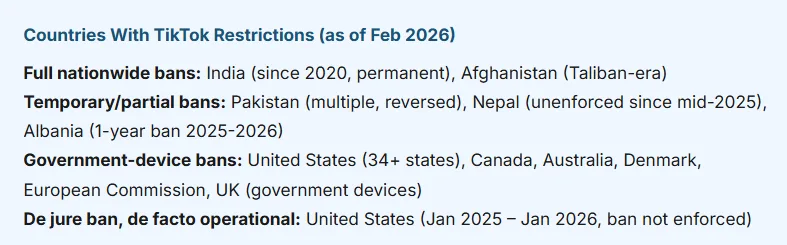
India banned TikTok in June 2020, removing it from a market of over 200 million users. It remains the only large-scale TikTok ban that persisted. The result? Instagram Reels launched in India as a direct replacement and captured much of TikTok’s former user base. YouTube Shorts followed. Indian short-form content creation migrated to American platforms, which was, arguably, the actual policy goal.
But India’s ban was part of a broader action against 509 Chinese apps following a deadly border clash between Indian and Chinese troops. The ban was geopolitical retaliation, not a data-protection initiative. India has no comprehensive data-protection framework comparable to the EU’s GDPR, and Indian-made apps collect data with minimal regulation.
The pattern that emerges
Pakistan imposed temporary bans multiple times and reversed them. Afghanistan banned TikTok under Taliban governance. Nepal banned TikTok and then failed to enforce it; by mid-2025, users reported accessing TikTok without VPNs despite the official ban remaining in force. Albania banned TikTok for one year in 2025 after a teenager stabbed a classmate over a social media dispute a tragedy, but not a data-security rationale.
The consistent finding: bans that are motivated by genuine technical concerns rarely exist. Most bans are responses to cultural panic, geopolitical tension, or political optics. VPNs bypass all of them. And the countries that implement bans rarely invest in the comprehensive data-privacy infrastructure that would actually protect their citizens.
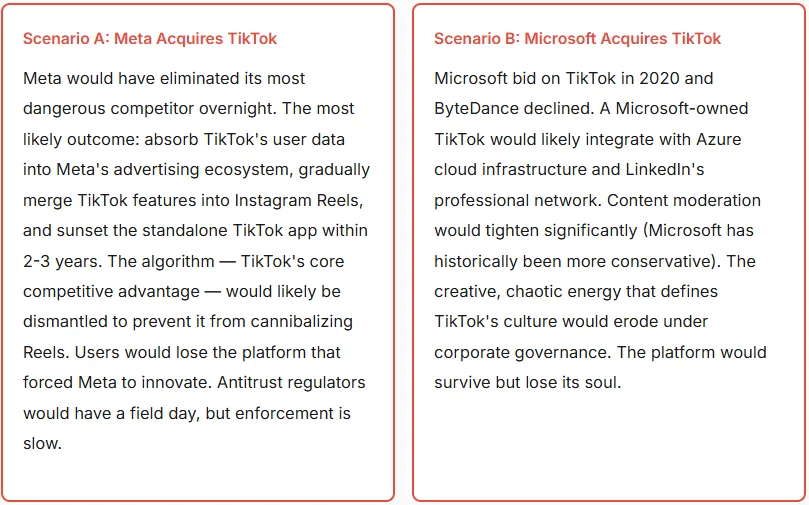
The alternative timeline: what if TikTok was actually sold to Meta, Microsoft, or Apple?
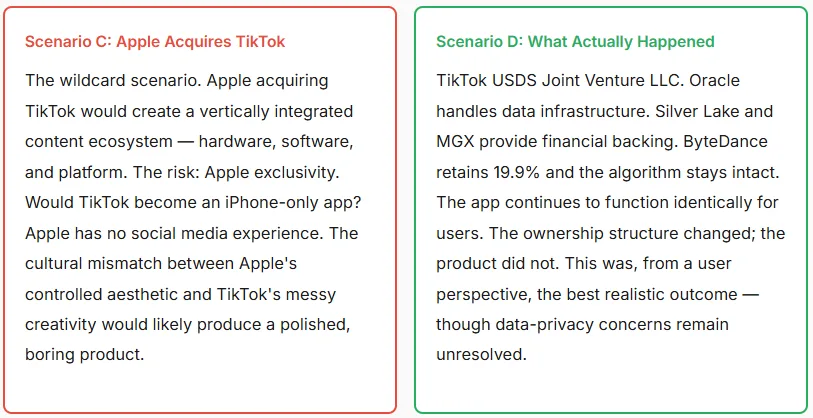
During the ban saga, several major companies expressed interest in acquiring TikTok. Each acquisition scenario would have produced radically different outcomes for users, creators, and the competitive landscape. Let’s model what each would have meant.
The January 2026 deal: who owns TikTok now?
On January 22, 2026, TikTok USDS Joint Venture LLC officially launched. Here’s the ownership breakdown:
Several structural details matter. Oracle, headed by Trump ally Larry Ellison, already oversaw TikTok’s U.S. user data under Project Texas since 2022. The deal deepened that relationship. ByteDance has no controlling interest but retains meaningful ownership. The algorithm, the software engine that makes TikTok’s feed addictive, continues to operate. The White House valued the deal at approximately $14 billion, according to Brookings Institution analysis.
From a practical standpoint, nothing changed for users. Same app, same feed, same algorithm, same content. The politics resolved; the product persists.
How to restore TikTok on iPhone after the ban
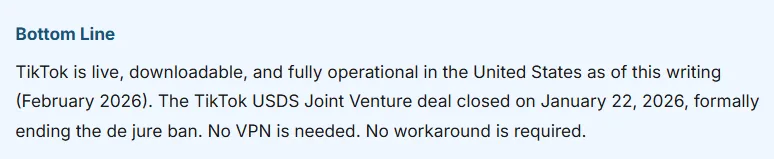
As of February 2026, TikTok is fully available on both the Apple App Store and Google Play Store. If you’re still experiencing issues, perhaps from residual restrictions, regional settings, or account complications, here are verified solutions based on what we tested during and after the ban period.
If you never deleted TikTok
Your app should function normally. If it’s behaving erratically, force-quit the app, check for updates in the App Store, and ensure your iOS is current. The January 2025 blackout occasionally corrupted local cache files. If you see stale content or loading errors, delete and reinstall the app from the App Store, it’s available again.
If you deleted TikTok during the ban
Open the App Store, search for “TikTok,” and download it normally. The app has been continuously available since February 13, 2025. Log in with your existing credentials. Your account, followers, and content were preserved through the ban period, ByteDance maintained all user data on its servers throughout.
If you’re on a managed device (corporate or government)
At least 34 U.S. states ban TikTok on government-issued devices. If your device is managed by an organization with mobile device management (MDM) profiles, TikTok may still be blocked regardless of its App Store availability. This is an organizational policy, not a federal ban. Check with your IT department.
If you downloaded a VPN or sideloaded TikTok during the ban
Some users installed TikTok via sideloading or third-party app stores during the ban. Now that the official version is available, delete any sideloaded versions and reinstall from the official App Store. Unofficial versions may contain modified code or security vulnerabilities. The official App Store version is audited by Apple’s review process.
What this actually taught us
The TikTok ban saga, spanning from PAFACA’s passage in April 2024 through the deal’s closure in January 2026, was the most expensive, most constitutionally questionable, and least effective data-privacy action in American legislative history. It produced no data-protection reform. It resulted in expanded data collection under the new privacy policy. It created a precedent where the executive branch claims power to nullify federal law through letters to corporations. And it left Meta’s surveillance apparatus entirely untouched while restructuring ownership of its competitor.
If you care about digital privacy, the TikTok ban was not a victory. It was a distraction from the comprehensive data-protection legislation that the United States still lacks, legislation that would apply equally to TikTok, Meta, Google, Amazon, and the data brokers who sell your location to government agencies without a warrant.
The ban was real. The security threat was hypothetical. The lobbying was documented. The hypocrisy was structural. And TikTok, same algorithm, more data collection, new owners—is still on your phone.