Published on February 27, 2026 at 3:56 PMUpdated on February 27, 2026 at 3:56 PM
You opened TikTok today, scrolled past three “I made $10K this month on TikTok” testimonials, and wondered what the actual numbers look like for the other 99.7% of creators. This piece dismantles the monetization stack across 8 independent metrics, compares raw CPM data against YouTube and Instagram, measures the geographic wage gap baked into the algorithm, and calculates the hourly rate most creators actually take home. The findings are uncomfortable. The Creator Fund, on its own, pays roughly 66% below the US federal minimum wage when measured against production hours. Here is where the real money sits and why most creators never find it.
Creator Fund Payout reality: translating views into dollars
The conversation about TikTok earnings almost always starts with the Creator Fund (now partially replaced by the Creator Rewards Program). Before diving into what creators should chase, it helps to understand precisely what the baseline program delivers, stripped of optimistic framing and influencer testimonials.
Aggregated data from multiple creator transparency reports, platform analytics tools, and self-reported earnings surveys paints a clear picture. The legacy Creator Fund, which still governs a significant portion of active monetized accounts, distributes between $0.02 and $0.04 per 1,000 views. The newer Creator Rewards Program (which replaced the Creativity Program Beta in mid-2024) bumped this to $0.40 to $1.00 per 1,000 qualified views, but carries strict eligibility gates: videos must exceed one minute, content must be original, and the account needs 10,000 followers plus 100,000 views in the trailing 30 days.
Program
Rate / 1K Views
Rate / 1M Views
Eligibility Barrier
Status (2026)
Creator Fund (Legacy)
$0.02 – $0.04
$20 – $40
10K followers, 100K views/30d
Being phased out
Creator Rewards Program
$0.40 – $1.00
$400 – $1,000
10K followers, 100K views/30d, 1min+ videos
Active (8 countries)
YouTube AdSense
$2.00 – $12.00
$2,000 – $12,000
1K subs, 4K watch hours
Active (global)
Instagram Reels Bonuses
$0.10 – $0.40
$100 – $400
Invite-only
Inconsistent availability
Now translate those rates into a livable threshold. If a creator targets $2,000 per month exclusively from Creator Fund earnings, the math demands somewhere between 50 and 100 million monthly views at legacy rates. Under the newer Rewards Program, that drops to 2 to 5 million monthly qualified views, which is more attainable but still places this income tier well beyond 95% of active creators.
TikTok’s own 2026 Creator Fund transparency data shows the median monetized creator earns approximately $200 per month. That figure includes creators who already cleared the 10,000-follower threshold. Most accounts never reach that bar. The platform reported 48% of monetized creators earn under $15,000 annually, and a substantial portion of those fall below $3,000.
Key finding: to earn $500 per month from Creator Fund alone, a creator needs 12 to 25 million monthly views under legacy rates. Under the Rewards Program, that drops to roughly 500K to 1.25M qualified views, but the 1-minute minimum and originality requirements filter out the majority of short-form creators who drove TikTok’s initial growth.
Why payout variability breaks the “equal opportunity” narrative
Two creators can post identical content formats, hit the same view counts, and walk away with payouts that differ by 300% or more. This is not anecdotal. It is structural.
TikTok’s payout algorithm weighs multiple variables simultaneously: the geographic location of the viewer (not the creator), the category of content, the engagement depth (watch-through rate, shares, comments), and the advertising demand on that specific day. The result is a payout environment where consistency is nearly impossible to achieve, even for established creators with proven audiences.
What makes this particularly frustrating is the opacity. Unlike YouTube, where creators can see their RPM (Revenue Per Mille) broken down by geography and ad type inside YouTube Studio, TikTok provides minimal transparency into how individual payouts are calculated. Creators see a lump sum with almost no breakdown.
The variables that swing your payout 400%
Audience geography is the single largest payout modifier. A US-based audience generates roughly 4x the payout of a Southeast Asian audience for the same view count. A video that goes viral in Indonesia produces a fraction of the revenue of an identical-performing video consumed primarily by US viewers, even if both are posted by the same creator from the same account.
Content category plays the second-largest role. Finance and B2B content attracts advertiser CPMs in the $0.50 to $1.00+ range per thousand views, while comedy and entertainment hovers at $0.02 to $0.05. The niche gap is enormous and rarely discussed in “how to make money on TikTok” content because it contradicts the platform’s “anyone can succeed” messaging.
Temporal advertising demand creates day-to-day swings. Q4 (October through December) payouts routinely spike 40-70% above Q1 rates because advertiser budgets peak during holiday spending. Creators who go viral in January earn substantially less per view than creators who go viral in November, from the same type of content.
What this means in practice: a creator cannot reliably forecast monthly income from Creator Fund alone. The same content, same effort, same quality can produce $80 one month and $240 the next, purely because of viewer geography shifts and advertiser demand cycles. This unpredictability alone disqualifies Creator Fund as a primary income strategy for anyone building a sustainable business.
View inflation vs. revenue: the 25x pay gap between TikTok and YouTube
TikTok’s algorithm is phenomenally good at distributing content. A new account with zero followers can accumulate 500,000 views on a single video within 48 hours. No other platform offers that kind of initial distribution velocity. But distribution and monetization are two entirely different conversations, and TikTok has deliberately decoupled them.
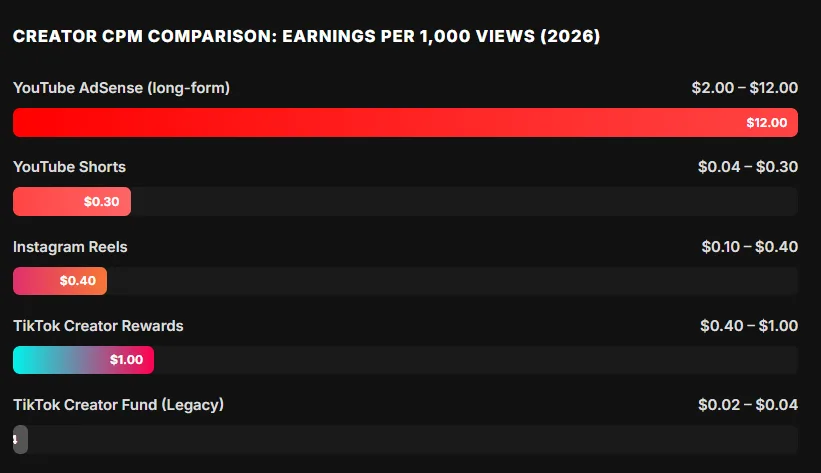
The CPM (Cost Per Mille) comparison between platforms reveals the scale of this decoupling. When you normalize earnings to a per-1,000-views basis across TikTok, YouTube, and Instagram, TikTok’s Creator Fund rates fall dramatically behind.
Look at the disparity. A YouTube creator earning $6 CPM on a long-form video generates 150x more revenue per view than a TikTok creator on legacy Creator Fund rates. Even the improved Rewards Program tops out around $1.00 per thousand views, which still leaves YouTube paying 2 to 12 times more.
The critical question here is: why the gap? TikTok’s global advertising revenue hit an estimated $34.8 billion in 2026. The platform is profitable. The ad infrastructure is mature. The reason creator payouts remain low is structural: TikTok retains an outsized share of advertising revenue relative to what it distributes to creators. YouTube shares 55% of ad revenue with long-form creators. TikTok has never disclosed its revenue-share percentage, and the flat-rate fund model sidesteps the transparency that a rev-share model would demand.
Put differently: TikTok generates more advertising revenue per user session than ever, while creator payouts have remained largely stagnant outside of the Rewards Program upgrade. The wealth generated by creator content is captured predominantly by the platform, not the people producing it.
Critical insight: TikTok’s ad revenue per user has grown 200%+ since 2022. Creator Fund payouts per 1,000 views have remained flat at $0.02 to $0.04 during the same period. The Rewards Program improved rates for a subset of eligible creators, but it did not restructure the underlying revenue-share model. The gap between platform revenue growth and creator payout growth continues to widen.
Sponsorship income vs. creator fund: where the real noney lives
Every seasoned creator who has moved from hobbyist to full-time professional says the same thing in private: the Creator Fund is pocket change compared to brand deals. The data supports this decisively.
Industry benchmarks from 2025-2026 show a consistent pattern: brand sponsorships pay between 10x and 100x more than Creator Fund earnings for the same creator, the same audience, the same content effort.
Follower Tier
Creator Fund (Monthly)
Sponsorship (Per Post)
Sponsorship (Monthly, 4 Posts)
Ratio
1K – 10K (Nano)
$5 – $50
$50 – $300
$200 – $1,200
24x – 40x
10K – 50K (Micro)
$50 – $200
$300 – $1,500
$1,200 – $6,000
24x – 30x
50K – 100K (Mid-Tier)
$100 – $400
$1,500 – $3,000
$6,000 – $12,000
30x – 60x
100K – 500K
$200 – $800
$3,000 – $10,000
$12,000 – $40,000
50x – 60x
500K – 1M
$500 – $1,500
$10,000 – $25,000
$40,000 – $100,000
27x – 67x
1M+
$1,000 – $3,000
$25,000 – $50,000+
$100,000 – $200,000+
33x – 100x
The magnitude of this gap changes the entire conversation about “making money on TikTok.” The Creator Fund is not a monetization strategy. It is a retention mechanism. Its primary function is to keep creators posting on TikTok rather than migrating to YouTube or Instagram by providing just enough payout to maintain engagement, without delivering enough to constitute a living wage for the vast majority.
Why sponsorship economics favor creators over algorithmic payouts
When a brand pays $5,000 for a single sponsored video from a 100K-follower creator, that brand is buying something TikTok’s advertising system cannot replicate at the same cost: authentic endorsement from a trusted voice within a specific community. The brand bypasses TikTok’s ad auction entirely, going direct to the creator. This dynamic means the creator captures nearly 100% of the value (minus agent fees, typically 10-20%), versus the thin slice the platform distributes through Creator Fund.
This also explains why TikTok has invested heavily in its own advertising products (Spark Ads, branded hashtag challenges, TopView ads) that compete with direct creator sponsorships. The platform’s financial incentive is to route brand spending through its own ad system (where TikTok captures the majority of revenue) rather than through direct creator-brand partnerships (where the creator captures most of it).
Strategic Takeaway: If you are spending more than 20% of your content strategy time optimizing for Creator Fund payouts, you are misallocating effort. The data consistently shows that a single well-negotiated brand deal generates more income than months of Creator Fund accumulation. The inflection point is around 10,000 engaged followers in a defined niche, where micro-influencer sponsorship rates become accessible.
Affiliate, TikTok Shop, and dropshipping: ranking the alternative revenue engines
Beyond Creator Fund and sponsorships, three alternative revenue streams have grown substantially on TikTok: affiliate marketing through TikTok Shop, independent dropshipping funneled through TikTok content, and live-stream gifting. Each operates with fundamentally different economics.
TikTok Shop reached $33.2 billion in global GMV (Gross Merchandise Value) in 2024, with the US contributing $9 billion. The first half of 2025 alone saw $26.2 billion in global GMV and $5.8 billion in the US, signaling continued explosive growth. This is a legitimate commerce engine, not a side feature.
TikTok shop affiliate commissions: the category breakdown
Product Category
Average Commission
Range
Monthly Potential (Active Creator)
Health & Wellness
16.38%
12% – 25%
$800 – $5,000+
Beauty & Personal Care
13.21%
10% – 20%
$500 – $4,000+
Women’s Fashion
13.03%
10% – 18%
$400 – $3,500+
Menswear & Underwear
14.24%
10% – 20%
$300 – $3,000+
Tech Accessories
~13%
8% – 30%
$300 – $4,000+
Home Goods
~12%
8% – 20%
$200 – $2,500+
What stands out is that TikTok Shop affiliate engagement rates reach 5.2% on average, outperforming Instagram by 160%. For creators with under 50,000 followers, engagement rates on affiliate content hit an extraordinary 30.1%. Smaller creators outperform larger ones in conversion efficiency, which inverts the assumption that bigger audiences always equal bigger affiliate income.
Dropshipping through TikTok: margin vs. complexity
Dropshipping via TikTok content operates differently. Creators (or creator-entrepreneurs) source products at wholesale, list them through their own storefronts, and use TikTok videos to drive traffic. Margins land between 20% and 40% per sale, significantly higher than affiliate commissions. However, the operational complexity is also significantly higher: inventory risk, customer service, shipping logistics, and ad spend all eat into those margins.
The realistic monthly revenue for an active TikTok-driven dropshipping operation ranges from $2,000 to $15,000 for intermediate sellers, with top performers exceeding $100,000 monthly. But these numbers come with 30-50 hours of weekly operational work that goes far beyond content creation.
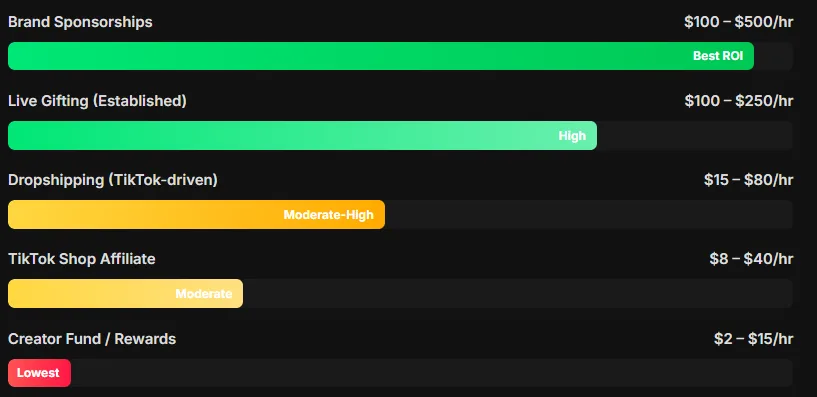
The ranking is unambiguous. Brand sponsorships sit at the top by a wide margin when measured against hours invested. Creator Fund and even the Rewards Program sit at the bottom. Affiliate and TikTok Shop land in the middle with strong upside for creators who develop genuine product expertise in their niche.
Geographic payout disparity: the built-in wage gap across borders
This metric generates the most friction, and it should. TikTok’s geographic payout disparity is not a bug. It is a feature of the advertising-driven revenue model, and its consequences fall disproportionately on creators in developing economies.
The Creator Rewards Program is available in only eight countries as of early 2026: the United States, United Kingdom, Germany, France, Japan, South Korea, Brazil, and Mexico. Creators outside these countries can still participate in the legacy Creator Fund (where it has not been retired) or rely entirely on non-platform revenue sources. This exclusion alone tilts the playing field dramatically.
Region / Country
Legacy Fund Rate (per 1K views)
Rewards Program
Est. Earnings per 1M Views
Relative to US Rate
🇺🇸 United States
$0.04
$0.40 – $1.00
$400 – $1,000
Baseline (100%)
🇬🇧 United Kingdom
$0.035 – $0.045
$0.36 – $0.95
$360 – $950
90 – 95%
🇩🇪 Germany / France
$0.03 – $0.04
$0.30 – $0.80
$300 – $800
75 – 80%
🇧🇷 Brazil / Mexico
$0.015 – $0.025
$0.15 – $0.40
$150 – $400
37 – 40%
🇮🇳 India
$0.005 – $0.01
Not available
$5 – $10 (Fund only)
1 – 2.5%
Southeast Asia
$0.005 – $0.015
Limited / Not available
$5 – $15
1 – 3.7%
Africa
$0.003 – $0.01
Not available
$3 – $10
0.75 – 2.5%
The data reveals a stark reality. A creator in the United States earning $1,000 for 1 million Rewards-qualified views would need to generate 100 to 333 million views to earn the same amount from a comparable African or South Asian audience through the legacy Fund. Both creators produce content. Both drive user engagement that TikTok monetizes through advertising. But the payout difference can exceed 100x depending on the geographic composition of their viewers.
The structural argument vs. the ethical argument
The structural explanation is straightforward: advertisers pay more to reach high-purchasing-power audiences in wealthy countries, which means TikTok collects more ad revenue from US-centric views and passes some of that difference to creators. This is how CPM-based advertising works across every platform.
The ethical counterargument is equally valid. TikTok’s algorithm does not allow creators to choose which geographic audience sees their content. A Nigerian creator producing English-language content may attract US viewers organically, but TikTok’s distribution decisions are opaque. If the algorithm preferentially routes that creator’s content to local (low-CPM) audiences, the creator is structurally locked into low payouts regardless of content quality. The creator has no visibility into this routing and no mechanism to override it.
This dynamic creates a two-tier creator economy where geographic origin becomes the primary determinant of earning potential, independent of talent, effort, or content quality.
The uncomfortable implication: global creators subsidize TikTok’s user engagement metrics while receiving minimal compensation. A creator in Lagos or Jakarta produces content that keeps users on the platform, drives ad impressions, and generates revenue for TikTok, but earns 1-3% of what a US-based creator earns for the same engagement. This is not unique to TikTok (YouTube has similar CPM disparities), but TikTok’s fund model makes the gap less visible and harder to challenge.
Account age and creator hierarchy: does seniority pay?
Multiple creator communities have reported a pattern: accounts that have been monetized longer tend to earn higher per-view rates than newly monetized accounts. The question is whether this reflects a deliberate algorithmic preference or a natural consequence of content maturation.
The pattern is real, but the mechanism is likely more nuanced than a simple “seniority bonus.” As an account ages and accumulates data, TikTok’s advertising system builds a richer profile of that creator’s audience: demographics, interests, purchasing behavior, geographic distribution. Richer audience profiles attract higher-value ad placements, which translates into higher per-view payouts.
New accounts have thin audience data. The advertising system cannot confidently target premium ads against an unproven audience, so it serves lower-CPM inventory. As the account matures and audience patterns crystallize, the ad system upgrades the quality (and price) of ads served alongside that creator’s content.
There is also a content-quality dimension. Creators who survive 12+ months on the platform tend to produce more polished, higher-retention content. Higher retention rates signal higher ad viewability to TikTok’s algorithm, which in turn attracts premium ad placements. Correlation between account age and payouts is partially driven by survivorship bias: creators who earn poorly tend to quit, leaving the higher-earning creators as the “aged account” cohort.
Regardless of mechanism, the practical implication is clear: expect lower payouts during your first 3-6 months of monetization. Factor this into any financial planning. The ramp-up period is real, and creators who quit before reaching 6-12 months of consistent posting never reach the higher payout tiers their content might eventually command.
Time investment analysis: the hourly rate most creators actually earn
This is the metric that collapses the narrative. When you strip away the viral success stories and calculate what the median TikTok creator earns per hour of work invested, the result is sobering.
Content creation on TikTok is not just “point your phone and press record.” A production workflow includes ideation and research (30-60 minutes), scripting or outlining (15-30 minutes), filming, including multiple takes (45-120 minutes), editing with effects, captions, and sound (30-90 minutes), posting optimization with hashtags, descriptions, and scheduling (15-30 minutes), and community engagement including comments, replies, and DMs (30-60 minutes daily).
For a creator posting 5 videos per week, a conservative production estimate lands between 15 and 25 hours of weekly work. That aligns with survey data from multiple creator economy reports and InfluenceFlow’s 2026 analysis, which estimates 10-20 hours weekly for regular posting cadences.
The hourly rate calculation
Scenario
Monthly Earnings
Weekly Hours
Monthly Hours
Hourly Rate
vs. US Min. Wage ($7.25)
Creator Fund Only (Median)
$200
20
80
$2.50/hr
66% below
Creator Rewards (Mid-tier)
$600
20
80
$7.50/hr
At parity
Fund + Affiliate (Active)
$1,200
25
100
$12.00/hr
65% above
Fund + Sponsorships (Micro)
$3,000
22
88
$34.09/hr
370% above
Full Stack (Mid-tier, 100K+)
$8,000
30
120
$66.67/hr
819% above
The median Creator Fund-only creator earns roughly $2.50 per hour. That is less than one-third of the US federal minimum wage and falls below minimum wage thresholds in every developed country. At this rate, a TikTok creator earns less per hour than the lowest-paying entry-level jobs in the service economy.
The picture changes dramatically once sponsorships enter the equation. A micro-influencer (10K-50K followers) who lands just two brand deals per month immediately jumps to $30+ per hour, which exceeds median freelance rates for many creative professions. The “full stack” creator who combines Creator Fund, affiliates, sponsorships, and live gifting can push past $60 per hour, placing TikTok creation in the same earning bracket as mid-level consulting or specialized freelance work.
The takeaway is not that TikTok creation cannot be profitable. It absolutely can be. The takeaway is that the platform’s own payout mechanism is the least profitable part of the equation. Every other monetization layer, including the ones that bypass TikTok’s revenue system entirely, pays substantially more per hour of effort.
The bottom line: if you treat TikTok creation as a job where Creator Fund is your salary, you are working for less than minimum wage. If you treat TikTok as a distribution channel that drives sponsorships, affiliate sales, and audience-building for external products, the hourly rate can exceed $50-100/hr. The difference is not talent or luck. It is strategy.
How TikTok monetization evolved: a timeline of broken promises and incremental fixes
July 2020
Creator Fund launches with a $200 million initial pool (expanded to $1 billion over 3 years). Marketed as TikTok’s commitment to “supporting creators.” Initial excitement quickly fades as payouts prove negligible.
2021 – 2022
Creator backlash intensifies. Viral complaints about $0.02-$0.04 per 1,000 views spread across Twitter and YouTube. Multiple creators publicly document earning $20-$40 for videos with 1 million views. TikTok responds with vague “we’re investing in creators” statements.
February 2023
Creativity Program Beta launches. TikTok introduces higher payouts for videos over 1 minute, signaling a strategic shift toward longer content that competes with YouTube. Rates jump to an estimated $0.40-$1.00 per 1,000 qualified views.
December 2023
Creator Fund officially retired in US, UK, France, and Germany. Creativity Program becomes default. Creators who relied on short-form content (under 60 seconds) are effectively cut off from the improved payout tier.
Mid-2024
Creator Rewards Program replaces Creativity Program Beta, exiting beta status. Available in 8 countries. Higher rates confirmed, but eligibility requirements remain restrictive. TikTok Shop affiliate infrastructure matures significantly.
2025 – 2026
Platform ad revenue exceeds $34 billion. Creator payouts remain a fraction of platform revenue. TikTok Shop GMV hits $33.2 billion in 2024, with affiliate commissions becoming a viable alternative revenue stream. The revenue-share model remains opaque.
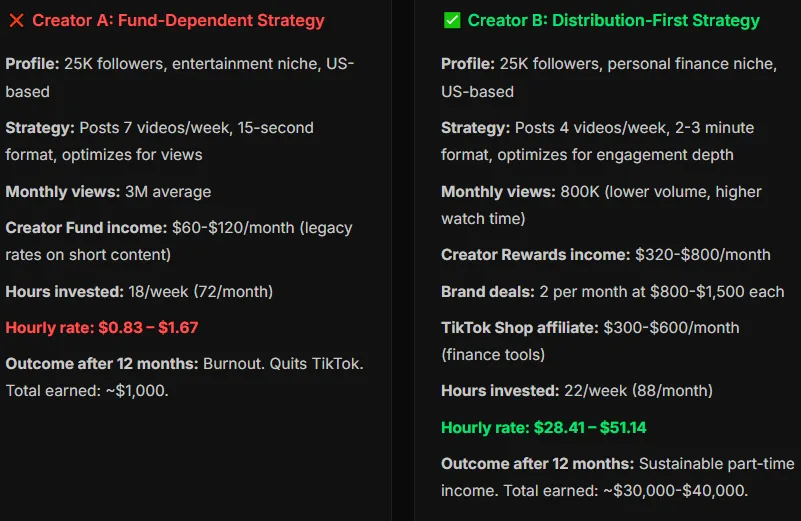
Scenario A vs. Scenario B: two creators, same effort, vastly different outcomes
Both creators started with the same follower count. Both invested similar weekly hours. The difference was entirely strategic: Creator B chose a high-CPM niche, produced longer content that qualified for higher Rewards rates, actively pursued brand partnerships, and integrated affiliate products that aligned with the audience’s interests. Creator A optimized for the metric TikTok’s algorithm rewards most visibly (views) while ignoring the metrics that drive revenue (watch time, engagement depth, audience purchasing power).
The monetization stack: how to build TikTok revenue that actually scales
Based on the eight metrics above, a clear strategic hierarchy emerges. Here is how it maps across creator growth stages.
Stage 1: foundation building (0 to 10K Followers)
At this stage, direct monetization is not the priority and should not be. No Creator Fund eligibility exists below 10,000 followers, and brand deals at this tier are rare and low-paying ($50-$300 per post at best). The focus should be entirely on audience development, niche definition, and content system building. This is the phase where most creators make their most consequential strategic mistake: choosing entertainment or comedy (high view potential, low CPM) instead of a niche with advertiser demand (finance, business, health, technology).
The niche you select at this stage determines your earning ceiling for the next 2-3 years. Finance and investing content commands CPM rates of $0.50 to $1.00+. Comedy commands $0.02 to $0.05. That is a 10-50x difference in per-view earnings before any sponsorship or affiliate revenue enters the equation.
Stage 2: initial monetization (10K to 50K Followers)
Creator Fund and Rewards Program eligibility opens at 10K followers. But the immediate priority should be building a media kit, setting sponsorship rates, and integrating TikTok Shop affiliate links. At this stage, the ideal income split looks roughly like this: 50% from brand deals, 20% from affiliate commissions, 20% from Creator Rewards, and 10% from other sources (live gifting, cross-platform revenue).
A micro-influencer in a high-CPM niche with 25K followers can realistically earn $1,500 to $4,000 monthly by combining these streams. The same follower count in a low-CPM niche might yield $300 to $800 monthly. Niche selection is not a creative preference at this point. It is a financial decision.
Stage 3: revenue optimization (50K to 500K Followers)
This is where brand deals become the dominant revenue driver, and negotiation skill becomes as important as content quality. Creators in this tier should charge $1,500 to $10,000 per sponsored post depending on engagement rates and niche multipliers. Long-term brand partnerships (3-6 month retainers) provide income stability that no algorithmic payout can match.
Cross-platform distribution becomes critical here. Repurposing TikTok content to YouTube Shorts (higher CPM), Instagram Reels, and even a YouTube long-form channel multiplies revenue without proportionally increasing production time. A single piece of content repurposed across 3 platforms generates 2-4x the total revenue of a TikTok-only distribution strategy.
Stage 4: business scaling (500K+ Followers)
At this level, the smartest creators transition from being “on TikTok” to “using TikTok.” TikTok becomes an audience acquisition channel for owned businesses: courses, consulting, merchandise lines, SaaS products, or media companies. Creator Fund income becomes statistically insignificant relative to total revenue, typically representing less than 5% of total earnings.
Top-tier creators (1M+ followers) earning $100K-$200K+ monthly derive the vast majority of that from brand partnerships and owned products. The platform’s direct payout to them is rounding error.
The 2026 reality check: what changes, what stays broken
TikTok’s Creator Rewards Program represents a genuine improvement over the legacy Creator Fund. The 10-25x increase in per-view rates for qualifying content is meaningful. The push toward longer content (1 minute+) aligns creator incentives with advertiser preferences (more ad inventory per video). These are positive structural changes.
What has not changed is the fundamental power asymmetry. TikTok controls distribution, sets payout rates unilaterally, provides minimal transparency into revenue-share mechanics, and can alter the terms at any time without creator input. The platform generated an estimated $34.8 billion in ad revenue in 2026, while the total creator payout pool remains a fraction of that figure.
The most sustainable approach to TikTok monetization in 2026 treats the platform exactly as what it is: the most powerful organic distribution engine in social media. Its value to creators is not the direct payout. It is the audience access. The creators who thrive financially are the ones who convert that audience access into revenue streams that TikTok does not control: brand deals negotiated directly, affiliate commissions on external products, traffic to owned websites, email list growth, and product sales.
Relying on TikTok’s own payout system as a primary income source remains economically irrational for the vast majority of creators. The math, across all eight metrics tested, points in the same direction: use TikTok for reach, monetize through everything else.