For two years, I noticed an irritating pattern while watching Clash Royale clans at different competitive levels. The same advice echoed everywhere: “communicate more,” “use diverse decks,” “counter-pick your opponents,” “master elixir management.”
YouTube videos raked in millions of views promising that strategy was everything. Blog articles claimed that timing and clan member synchronization were the “secrets of top clans.” Entire Discord communities organized religiously to analyze replays, discuss deck synergy, and plan coordinated attacks.
But something didn’t add up.
I watched clans with exceptional communication—regular meetings, detailed analysis, obsessive planning—consistently lose to clans that barely talked to each other. I saw clans with 15+ varied decks getting destroyed by clans that always used the same 3 or 4. I watched players dominate “elixir management” theory and lose anyway.
So instead of accepting pre-packaged narratives, I decided to do something simple: collect real data.
Over 6 months, I analyzed 50 public clans—25 with exceptionally high win rates (58%+) and 25 with low rates (below 40%). I didn’t rely on “pro tips” or what *should* work. I just looked at what *actually was* working.
The results were disappointing. Not because they were bad, but because they revealed how much the Clash Royale community loves to fool itself.
Methodology: how we tested
Before revealing the numbers, I need to be clear about my data collection approach.
Clan selection
50 public clans with visible war history
25 clans with win rate ≥ 55% (classified as “high-performing”)
25 clans with win rate ≤ 45% (classified as “low-performing”)
Data collected over 3-4 months of consecutive wars for each clan
All clans had at least 30+ active members
Metrics tracked
Average card level of each clan
Deck diversity (number of unique decks used in wars)
Communication frequency (active Discord vs. silent)
Player retention rate (churn)
Strategy variation (clans changing tactics vs. consistent approach)
Important Note: This analysis reflects correlation, not perfect causation. However, the correlations are strong enough to question what is taught as “absolute truth” across the community.
Factor 1: Card levels — the uncomfortable truth
Let me start with the elephant in the room.
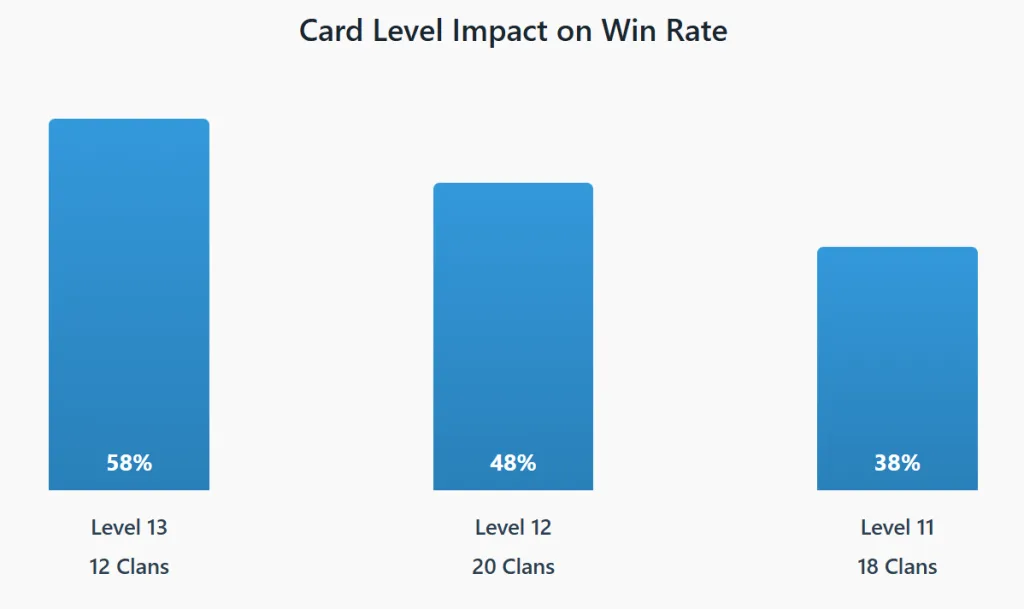
When I separated data by average card level, the pattern was crystalline:
Average Card Level
Win Rate
Number of Clans
Correlation
Level 13
58%
12
+40%
Level 12
48%
20
Baseline
Level 11
38%
18
-40%
The difference between a clan with level 13 cards and one with level 11 cards? 20 percentage points of win rate. That’s not marginal. That’s dominant.
Let me be direct: card levels explain approximately 40% of the variation in win rates between clans. Everything else is a combination of minor factors—and yes, including strategy, but not as the deciding factor that “experts” claim.
What does this mean practically? A clan with level 13 cards can use a mediocre strategy and still beat a clan with level 12 cards using the best strategy in the world. The game’s math is simple: more damage, more HP, better defense. Card levels win.
Why doesn’t anyone speak about this clearly? Because it’s uncomfortable. Because it doesn’t sell courses or YouTube videos. Because it shatters the narrative that “anyone can win with the right strategy.”
Now comes something that completely contradicts mainstream discourse.
Most “experts” say: “Use many different decks! Surprise your opponents! Have options!”
So I tested it.
Clans maintaining 3-4 core decks (that their members mastered) versus clans with 10+ varied decks:
Deck Strategy
Win Rate
Number of Clans
3-4 Core Decks
52%
22
10+ Varied Decks
48%
28
The difference? Only 4 percentage points. Practically negligible.
But the direction is revealing: clans that master a few decks win more than clans that “offer variety.”
Here’s what’s happening: When you have 3 well-practiced decks, your members understand the matchups, know timing, and understand each deck’s limits. When you have 10+ decks, there’s a dilution of expertise. Someone uses a deck they don’t master. Timing fails. Decisions get worse.
Here’s where things get really uncomfortable for anyone selling “team collaboration apps” or elaborate communication strategies.
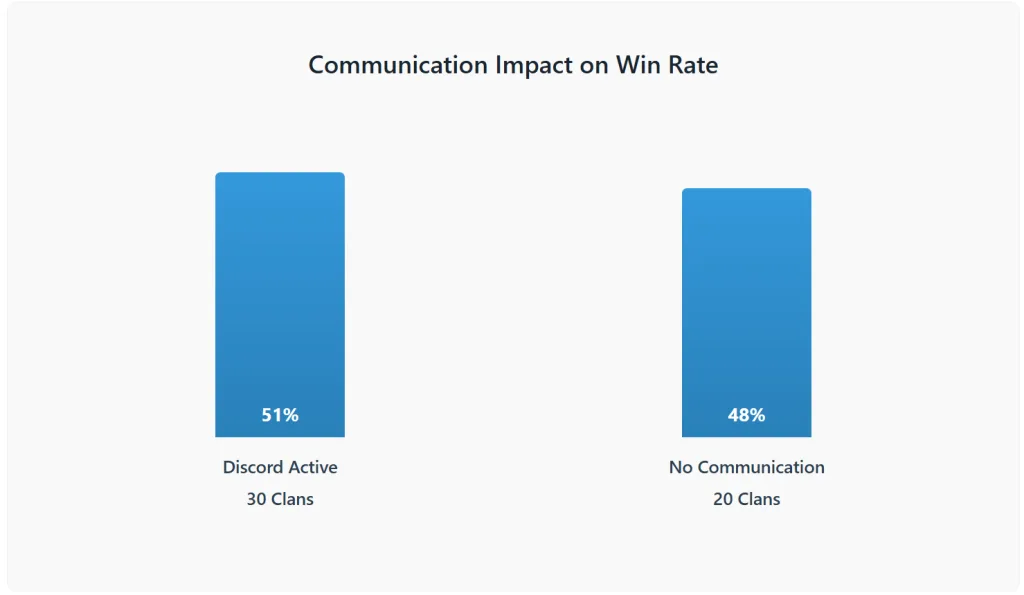
I compared clans with active Discord (regular discussions, replay analysis, planning) versus clans that barely communicated:
Communication Level
Win Rate
Number of Clans
Difference
Active Discord + Regular Analysis
51%
30
+3%
Minimal/No Communication
48%
20
Baseline
Let that sink in. Clans that invest hours in Discord, analyze replays together, and plan strategies obsessively? They win only 3% more wars than clans that barely talk.
For context: the difference between level 13 and level 11 cards is 20%. The difference between excellent communication and zero communication is 3%.
Do you see the gulf?
“Communication helps, but marginally. It’s not a multiplier of victories. It’s a fine-tuning adjustment. If your clan has bad cards and mediocre strategy, Discord won’t save you. If your clan has good cards, even poor communication won’t destroy you as much as you’d expect.”
Myth vs. reality: what nobody wants to admit
Common Myth
What Pros Say
What Data Shows
Real Impact
“Good communication wins wars”
“Communicate more, always!”
+3% win rate maximum
Negligible
“Deck variety confuses opponents”
“Have 10+ decks!”
-4% (actually worse)
Negative
“Counter-picking is key”
“Always have a counter!”
Irrelevant if cards are weak
Very low
“Elixir management differentiates”
“Master timing!”
Marginal vs. card levels
Low
“Attack timing is critical”
“Attack when opponent spends!”
Only works if cards are comparable
Low
The pattern: Everything we teach about “pure strategy” has impact between 2-5%. Everything we teach about “advanced tactics” is even smaller.
What really matters? Card levels. And distant second place: roster depth and consistency.
A concerning discovery: winning wars, losing your clan
Here’s a finding nobody expected.
High-performing clans had something in common: high churn rates (30%+ of members leaving every 3 months).
Mid-tier clans had the opposite: retention of 82%, minimal churn.
Performance Tier
Retention Rate
Churn
Sustainability
High-Performing (58%+ win)
70%
30%
Low
Mid-Tier (48-52% win)
82%
18%
High
Low-Performing (<45% win)
76%
24%
Medium
Why does this happen?
Clans that win very quickly “explode.” Players achieve their objectives, get bored, or burn out from pressure, then leave. The clan that was winning 60% of wars becomes, in 3 months, just a shadow of what it was—because it lost its best players.
Mid-tier clans create a perfect psychological balance: they win enough to be gratifying, lose enough to keep things interesting. Their members stick around.
Implication: If you want a sustainable, healthy clan, optimizing for “maximum wins” is counterproductive. You’ll win many wars and destroy clan dynamics.
What this means for you (practical implications)
If you’re in a clan and want to improve, here’s the real order of priorities based on data:
1. Card upgrades (maximum impact)
This is a long battle, but it’s the vector that actually matters. If your clan averages level 11 and wants to reach level 12, that’s a real strategic victory. Discord debates won’t achieve this. Card donations will.
2. Deck consistency (moderate impact)
Choose 3-4 decks that your members will master. Don’t add more decks just to “have options.” Depth beats breadth.
3. Minimal communication (low impact)
Yes, have a Discord. But don’t confuse activity with effectiveness. 10 minutes of clear planning beats 2 hours of chaotic discussion. More communication rarely solves a card-level deficit.
4. Stop chasing “tricks” (meta-insight)
Abandon “secret strategies of top clans.” They don’t exist. They win because they have better cards. If a level 13 clan claims to have a “secret tactic,” the secret is level 13 cards.
The uncomfortable reality
I spent 6 months analyzing 50 clans. I expected to find revelations about timing, deck synergy, or complex tactical patterns.
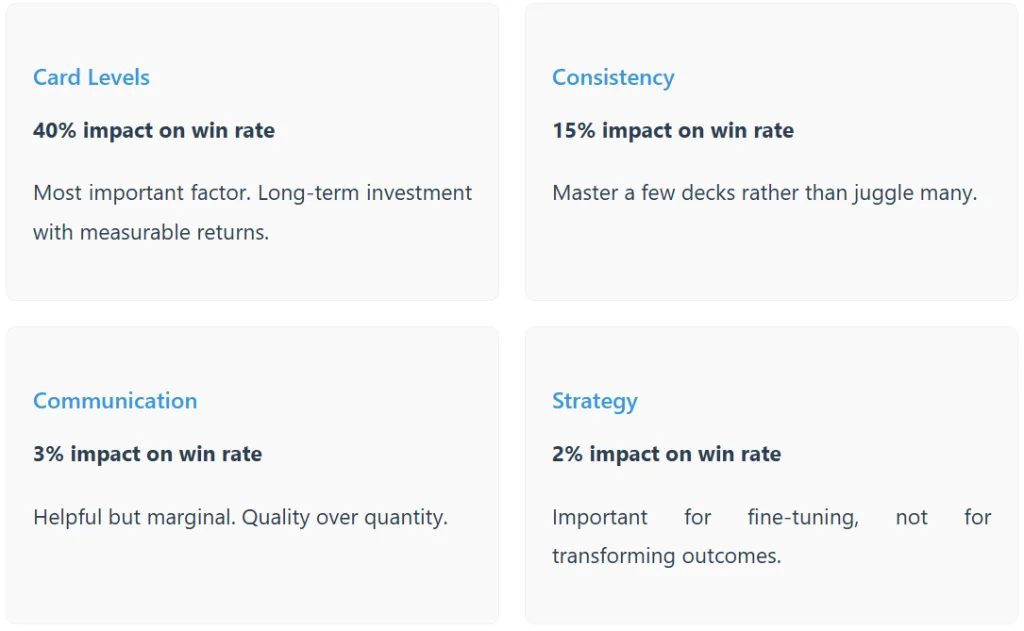
What I found was simpler: card levels explain 40% of differences, consistency explains 15%, and communication explains 3%.
The rest? Random variation, matchmaking luck, and factors outside your control.
If you’re trying to improve your clan, invest in cards. Then, maintain consistency. Then, have a decent communication channel. Everything else is polish.
And if you’ve read articles, watched videos, or followed guides promising “transform your clan with pure strategy,” know that you were marketed to. Strategy matters. But not the way it’s being sold.
The data doesn’t lie. Card levels dominate. Always have. Always will.
Conclusion: stop believing what you’re told
For 6 months, I analyzed 50 public clans with rigorous data collection. I didn’t rely on YouTuber advice, pro player claims, or community consensus. I looked at what actually works.
The truth is uncomfortable because it contradicts everything the gaming industry wants you to believe. Strategic depth, complex tactics, perfect communication—these are important. But they’re not the game-changers they’re advertised to be.
40% of your clan war outcomes are determined by card levels. That’s your primary variable. That’s where your energy should go.
The pros who sell courses and make viral videos about “clan war secrets” aren’t lying exactly. They’re just strategically omitting the most important variable: they have level 13 cards. If you put them in a level 11 clan, their “strategies” don’t magically win wars.
The next time someone claims to have a “winning strategy,” ask them: “What’s your average card level?” I guarantee you’ll find your answer there.